
Home / Contact
Contact the crew
How to Reach the Crew and Request a Locksmith
Our call line is coming soon. Until it is live, the request form on this page is the way to reach the crew. Here is what to put in it, what to have ready and what to expect once we have your message.
Start with the request form
The simplest way to reach us today is the request form on this page. The call line is coming soon, and we will not publish a number until it is real. Phone, email and street address details are not published yet, so please do not look for them elsewhere on the site.
A good request is short and concrete. It names the town, says what kind of lock or vehicle is involved and describes what happened in plain words. You do not need to know the correct names for the parts. If you can say that the key goes in but will not turn, or that the door shuts but the bolt does not slide, that is enough for the crew to begin planning.
If you are worried about whether your problem is big enough, the answer is that it probably is. We handle everything from a stiff deadbolt to a locked vehicle on a mountain road. Send the details, and we will tell you what the job involves.
Before you press send, read your message once more as if you were a stranger. Does it say where you are, what is wrong and whether anyone is in danger? If a friend could act on it without calling you back, the crew can too.
When to call emergency services instead
Some situations are not for a locksmith first. If a child or a pet is locked inside a vehicle, call emergency services right away. Closed vehicles heat up and cool down in ways that put lives at risk, and trained responders are the right people to act at once. Contact us afterward about the vehicle, but do not wait on us.
The same applies if someone is hurt, if you smell smoke or gas, if you are inside a building you cannot leave, or if you feel unsafe. A locksmith is a skilled tradesperson, not a first responder. Get help for the person first, and then deal with the door.
If you are unsure whether it counts as an emergency, treat it as one. A form is for lock and key problems. A situation involving danger belongs with the people trained to handle it.
Keep in mind that a locksmith cannot always solve every problem the moment it is reported, and that waiting around a locked car or a cold doorstep is uncomfortable. If you are unsafe, move to a safe place, call someone you trust and let emergency services know where you are.
What to tell us about your location
Location is the first thing the crew needs. Tell us the town and, where you can, the road, the nearest cross road or a landmark. We cover seventeen communities across Shasta County and Siskiyou County, from Redding and Anderson to Yreka and Etna, and the details matter most in rural places where addresses are hard to follow.
If the property has a gate, say so, and explain how to get through it. If the driveway is long or steep, mention that. If you are on a roadside, describe the direction of travel and anything that stands out. A short description saves time that would otherwise be spent searching.
Tell us if the location is safe to wait in. If you are alone on a quiet road at night, say so, and think about whether there is a safer place nearby. We would rather you be comfortable than stuck in a car on a shoulder.
It also helps to say what the area around the property is like. Dense trees, a steep slope, deep snow, a bridge or a narrow road can all change how a crew approaches. Mountain towns such as Mount Shasta and Dunsmuir often need these notes.
What to tell us about the lock
Describe the lock in whatever way you can. Is it a deadbolt, a knob, a lever handle, a padlock, a keypad or a smart lock? Is it on a house, a shop, a gate or a shed? Is it old or new? You do not need to name the make or model. A description such as a brass deadbolt above a silver handle gives us a useful picture.
Say what the lock does and does not do. The key may not enter. It may enter and not turn. It may turn but not move the bolt. It may be broken in the cylinder. The door may be shut with the bolt thrown, or merely closed on the latch. Each of these points toward a different cause and a different plan.
Mention what you have tried, too. If you sprayed something into the lock, say what. If you used a second key, say so. Even attempts that did not work tell us something. Please do not force the lock further, since a broken key adds a second problem to the first. Our guide to keys that will not turn helps you decide what to try.
If the lock is a padlock, tell us whether it is on a gate, a shed, a trailer or a storage box, and whether it is exposed to weather. Padlocks outdoors fail in different ways than locks inside a door, and the right hardware may differ.
What to tell us about a vehicle
For a vehicle, give the make, model and year, and say where it is parked. If the key is lost, tell us whether you have a spare. If the key is broken, keep the pieces. If a fob has stopped working, note whether the car shows any warning light when you try the buttons. Those details help the crew decide what equipment to bring.
The type of key matters. A simple metal key, a key with a plastic head containing a chip, a remote key fob and a push button start smart key are all different. If you are not sure what you have, say what it looks like. Our explanation of car key types in plain words can help you identify it.
Be ready to show that the vehicle is yours or that you have permission to use it. Registration or similar paperwork is helpful. It protects you, and it is a normal step for a responsible locksmith.
If more than one key is involved, such as a house key and a car key on one ring, mention both. We can often handle related problems in one visit, which saves you from arranging two.
What to have ready when the crew arrives
Before the crew arrives, gather a few things. Identification that matches the name on the property or vehicle. Proof of ownership or authority, such as paperwork or a lease. Any keys that still work, including partial ones. If you are a tenant, the name of the person who manages the property and how to reach them.
Clear the way. Move a vehicle that blocks a gate, turn on a porch light if it is dark and secure pets so the crew can work without distraction. If the work is on a door, keep the area around it clear.
We ask for proof of entitlement because we do not open locks for people who cannot show they belong there. That policy protects residents and owners alike, and it is common among careful locksmiths everywhere. If your documents are inside the locked space, tell us, and we will talk through what other proof might work.
If you are a business owner, add a line about the building. Say whether it is a storefront, an office, a warehouse or a yard, and whether the door is an exit path. The more we know about how the door is used, the better we can advise on hardware.
What happens after you send the form
After you send the form, the crew reads it and works out what the job needs. Where something is unclear, we may ask a follow up question. We do not promise a particular timeline from this page, because arrival depends on where the crew is, the road and the weather. We will give you realistic information once we have your details.
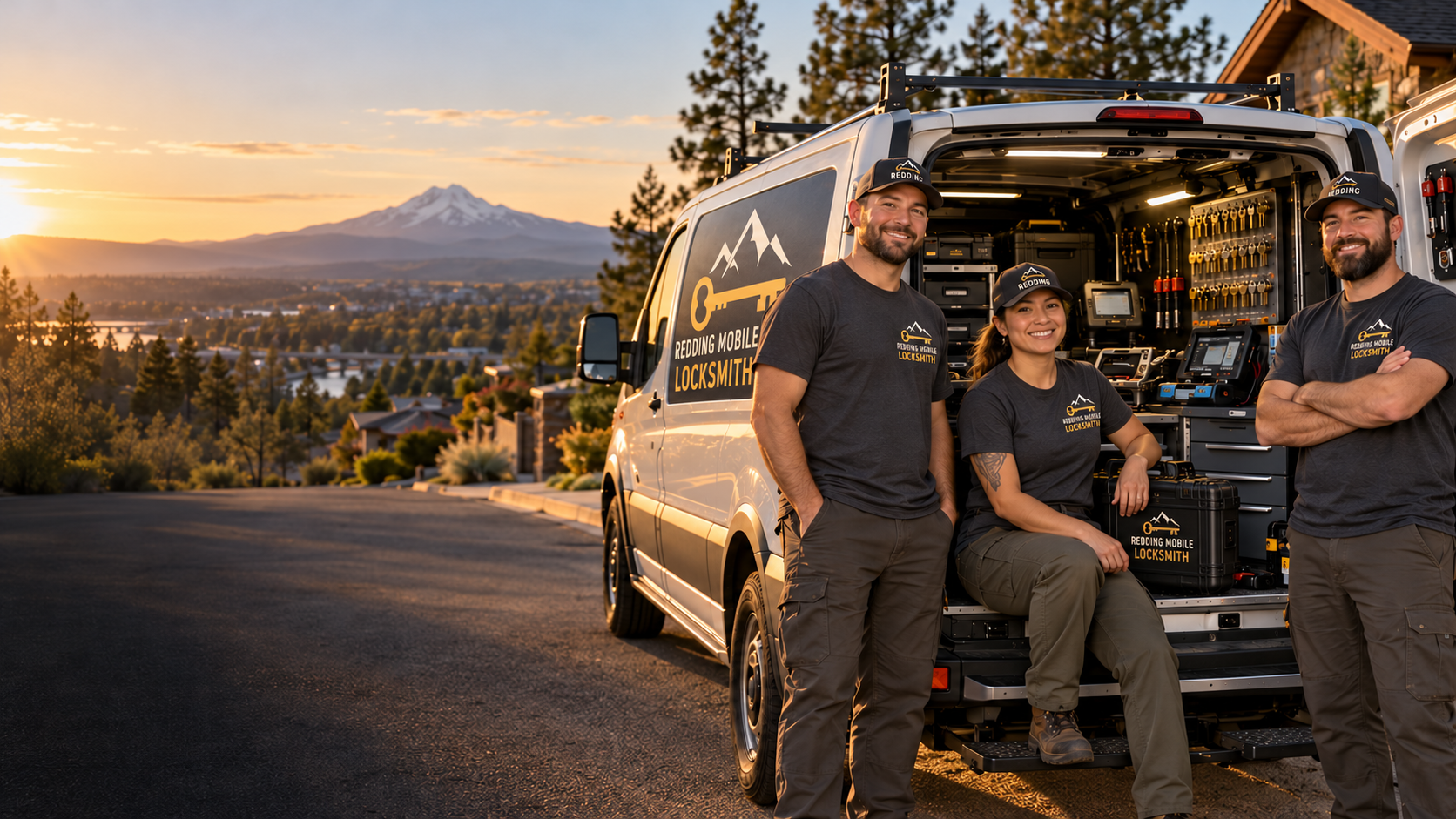
On arrival, you will see a uniformed team and a branded service van. They will introduce themselves, look at the lock or vehicle and explain what they plan to do. You decide whether to go ahead. If the plan changes once the lock is open and the real cause is visible, they explain the change and the reason before continuing.
When the work is done, test the result with the crew still on site. Turn the key, throw the bolt, try the spare, start the car. If something is not right, say so then. A working lock is the whole goal of the visit.
If you need to cancel the visit, tell us as soon as you can, using the same form or the call line once it is live. Cancelling frees the crew to help someone else. Perhaps a family member arrived with a spare, or the key turned up in a coat. We would rather hear that your problem is solved than send a crew to an empty driveway.
Which service fits your problem
If you are not sure how to describe your problem, this short guide may help. If you cannot get into a vehicle, see car lockout. If you cannot get into a home, see house lockout. If you lost a vehicle key or the fob stopped working, see car key replacement and key programming.
If you want old keys to stop working without replacing the hardware, read about rekeying. If a lock sticks, binds or feels loose, read lock repair. If you want new hardware, lock installation is the place to begin.
Businesses can look at commercial locksmith service and commercial door hardware. For late or urgent situations, the 24 hour emergency locksmith page explains how we approach them. You can also browse the full services overview.
Another way to choose is by asking what you want the lock to do next. If you want it to work, repair is likely. If you want it to be secret again, rekeying is likely. If you want it to be new, installation is likely. If you want access right now, lockout service is likely.
A few things we will not do
We do not open a lock for someone who cannot show they are entitled to access it. We do not give legal advice about who may change a lock, who owns a space or what a lease allows. If you are unsure about your rights, ask the property owner, your manager or a qualified professional.
We do not teach lock bypass techniques that could help someone break in. When we explain how locks work, we describe the mechanisms and what to do about problems, not how to defeat a lock that belongs to someone else.
We also do not publish prices, schedules or arrival promises on this page, because the right answer depends on the job. We will explain the work and what it involves before we begin, so you can decide with full information.
We also do not pressure anyone. If you want time to think about a repair, a replacement or a different lock, that is your decision. A good locksmith explains the options and then lets you choose.
How to prepare for the next time
Every lockout teaches the same lesson: a little planning saves a lot of stress. Keep a spare key with someone you trust. Write down the make, model and year of each vehicle, and keep your registration somewhere you can reach. Know which doors have deadbolts and which have only latches.
Think about your phone, too. Keep it charged, and know how you would use it if you were locked out at night. Save our contact page where you can find it, since the form is how you reach us until the call line goes live.
For more ideas, browse the field notes. A good starting point is storing spare keys safely and lost every key: what to gather.
Finally, keep a note of what work was done on each lock, and where the spare keys are. A page in a drawer can answer, years later, questions that would otherwise take a service call to settle.
Where we work
The crew serves seventeen communities. In Shasta County: Redding, Anderson, Shasta Lake, Cottonwood, Palo Cedro, Millville, Lakehead and Sims. In Siskiyou County: Mount Shasta, Yreka, Dunsmuir, McCloud, Weed, Granada, Montague, Fort Jones and Etna. Each has its own page with local detail.
If you live between two towns or on a road that crosses a boundary, name the one that is closest and describe the route. We would rather ask a question than send a crew to the wrong place.
To see the whole list, visit the areas page. To learn who we are and how we work, read the about page.
Common questions
Is there a phone number I can call right now?
Not yet. The call line is coming soon, and we will publish it only when it is live. Until then, use the request form on this page. Describe your town, the lock or vehicle and what happened. If someone is in danger or hurt, call emergency services instead of using a form.
What information should I put in the request form?
Include your town, the road or a landmark, the type of lock or vehicle and a short description of the problem. For a vehicle, add the make, model and year. Mention any gate, steep driveway or special access. The more concrete the details, the better prepared the crew will be on arrival.
Do I need to prove the home or car is mine?
Yes, you will be asked for identification and some evidence of ownership or authority before work begins, such as paperwork, a lease or a registration. This protects residents and owners, and it is a standard part of responsible locksmith work. If your papers are locked inside, tell us and we will discuss other options.
What if a child or animal is locked in a vehicle?
Call emergency services first. Closed vehicles can become dangerous within moments, and trained responders are the right first call. After help is on the way, you can send a request about the vehicle, but never wait for a locksmith when a life may be at risk.
Can you tell me the cost before you start?
We explain what the work involves before it begins, so you can decide whether to go ahead. We do not publish prices on this page because the right answer depends on the lock, the vehicle, the location and the work required. Ask when you send your request, and the crew will talk it through with you.
Which towns do you serve?
We serve seventeen communities in Shasta County and Siskiyou County, including Redding, Anderson, Shasta Lake, Cottonwood, Palo Cedro, Millville, Lakehead, Sims, Mount Shasta, Yreka, Dunsmuir, McCloud, Weed, Granada, Montague, Fort Jones and Etna. Each town has its own page on this site.
Need a locksmith?
Tell us where you are and what happened.
The call line is coming soon. Send your request here in the meantime.