
Why replacing a car key is more than cutting metal
Years ago a car key was a piece of brass cut to a pattern, and any hardware counter could copy it. Many keys today carry a small electronic chip, a remote, or both, and the vehicle expects to recognize that chip before it will run. A key that turns the ignition but cannot talk to the car is just a handle.
That is why replacement is really three jobs. One is making a physical key or blade that fits the lock. Another is preparing the electronic part so the vehicle accepts it. The third is making sure the lost key no longer works, if the situation calls for it, so that whoever finds it cannot drive away.
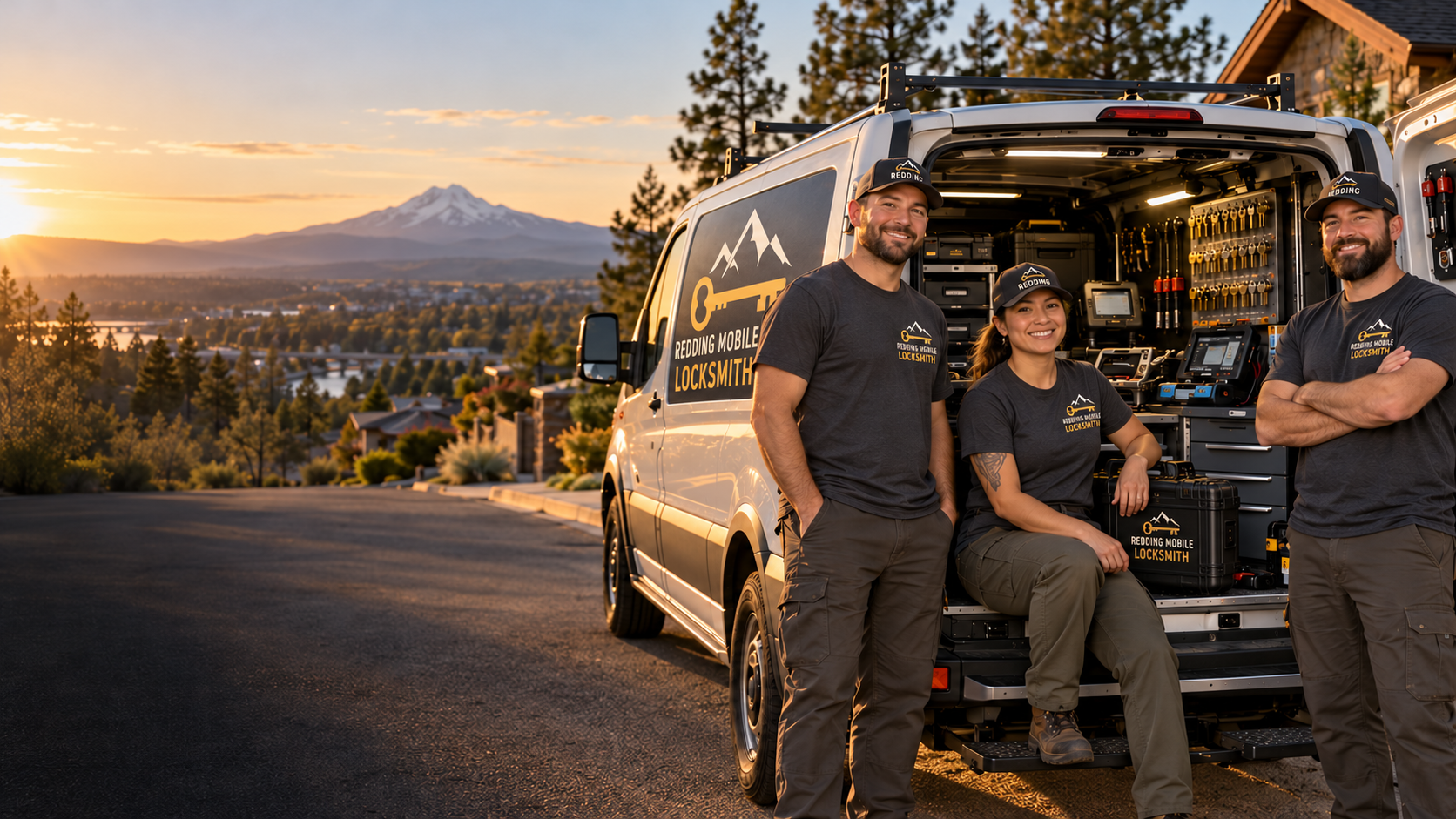
At Redding Mobile Locksmith we do these steps at the vehicle, using the equipment we carry in our branded service van. You do not have to tow the car to a shop or find a ride to a dealership. That is the whole idea of a mobile team, and it matters most when your car is parked on a mountain road, at a lake access or in a driveway in the middle of the valley.
The kinds of keys you may be replacing
The simplest car key is a plain metal blade with no chip. It opens the doors and turns the ignition, and nothing electronic is involved. Plenty of older vehicles in the North State still use these, and cutting a replacement is a mechanical job from start to finish.
Next comes the transponder key, which looks like a regular key with a thick plastic head. Inside the head sits a tiny chip that sends a coded response when the ignition cylinder energizes it. The vehicle compares that code to what it has stored and allows the engine to run only on a match. Our field notes page on transponder keys explained goes through the idea in plain words.
Beyond that are remote head keys, which combine a transponder with lock and unlock buttons, flip keys that fold a blade into a fob, and smart keys or proximity fobs that start a push button ignition without ever entering a slot. Each type calls for different equipment and a different procedure, and we ask which one you have before we come out.
What to gather before we arrive
The more you can tell us in advance, the smoother the visit goes. Start with the vehicle itself: the make, model and approximate model year, and the vehicle identification number if you can read it through the windshield or from your paperwork. The number lets us work out the exact key and chip type the vehicle uses.
Next is proof that the car is yours. A registration, a title, an insurance card or a similar record that matches your ID is the kind of thing a responsible locksmith asks to see. This is not an insult. A locksmith who makes a key for any car without asking is a danger to everyone, including you, and we will not do it.
Finally, gather any key you still have, even a broken one, and any remote or fob. A single working key makes replacement far simpler than starting from nothing, and a damaged key can still tell us a great deal about the cuts. If the key snapped, keep both pieces together in a clean bag or envelope.
- The make, model and approximate year of the vehicle.
- The vehicle identification number, read from the dash or your paperwork.
- Registration, title or similar proof that the vehicle is yours.
- A photo ID that matches the ownership record.
- Any working key, fob or broken pieces you still have.
When you have no key at all
An all keys lost situation sounds worse than it is. When no key exists, the work starts with the lock, not the key. The locksmith can read the lock or work from the vehicle's code, make a blade that fits, and then program the electronic side so the vehicle recognizes a new key. It takes more steps than a copy, but it is routine for a trained team with the right tools.
Vehicles differ widely in how they handle this. Some accept a new key through an onboard procedure. Others need diagnostic equipment connected to the vehicle's computer to add the key to its memory. A few demand additional security steps that take time, and we say so up front rather than letting you wait in the cold wondering.
Before we start, we check that nothing about the car's own condition blocks the process. A weak battery, a blown fuse, or a damaged ignition can look like a key problem and not be one. Our page on key programming describes the electronic side in more detail.
Replacing a broken or worn key
A key that has snapped off or worn smooth is a different story from a lost one. If you still have a working copy, replacement is usually simpler: we cut a new blade, program the chip, and test every function. If the broken half is stuck in a lock or ignition, we deal with that first, carefully, because forcing it out can damage the cylinder.
Wear is gradual and often goes unnoticed. A key that has been copied from a copy loses accuracy at each step, and after several generations the cuts no longer match the lock well. The symptoms are a key that sticks, a lock that needs jiggling, or an ignition that turns only in a certain position. Our page on what happens when a key wears down shows how this develops.
If the worn key is the only one you have, treat it as a warning. Replace it before it fails, not after. A fresh key cut from the lock or from the vehicle's code gives you a clean pattern, and a spare made at the same visit protects you from the next surprise.
How the job goes at the vehicle
Our team arrives in uniforms and a branded service van, and the first thing we do is confirm who you are and that the vehicle is yours. We then identify the key type, either from what you can show us or by looking at the vehicle. This is where the information you gathered earns its keep.
Next we cut the key if a blade is needed. A cutting machine in the van lets us do this on site, matching the pattern to the lock or to the code we have for the vehicle. We then program the chip and any remote functions using our equipment, and we confirm that the key starts the engine, opens and locks the doors, and works every button.
Before we leave, we test everything twice. The key should turn smoothly, start the engine without hesitation, and work every function you expect. If something does not behave as it should, we resolve it while we are still at the car rather than sending you off with a half finished job.
Working at the vehicle also spares you the trouble of moving it. Some cars are awkward to tow without a key because the steering column locks, the shifter stays in park, or the wheels will not turn freely. A mobile team skips all of that, which matters when you are at a trailhead, a work site or a roadside pull out and have somewhere to be afterward.
Smart keys and push button vehicles
Push button start vehicles do not use a key in a slot. A proximity fob lives in your pocket, and the car senses it nearby through low power radio signals. When you press the button, the vehicle checks that the correct fob is within range and then allows the engine to run. If the fob is gone, the car has nothing to check against.
Replacing these fobs tends to be more involved. The new fob must be matched to the vehicle, and in most cases the old fob has to be removed from memory so that a lost one cannot be used. That step is worth doing whenever the key was lost rather than just broken, because proximity fobs can sometimes be used from a short distance.
If your fob is working but the battery is weak, you may not need a replacement at all. Our guide on key fob battery basics explains the signs, and a fresh battery solves the problem more often than people expect.
Spare keys, and why now beats later
The easiest key to get is the one you made before you lost the last one. Duplicating a key you already have is simpler than creating one from nothing, because the locksmith can read the existing pattern and clone the electronic part from a working key. Starting from zero involves more steps for the same result.
It also helps to think about who drives the vehicle. A family with two drivers and one key is a family waiting for a bad morning. A work truck that gets passed between employees should have a spare in a controlled place. We cover this in more depth in our guide on a spare key now versus later.
If you replace a lost key, we encourage a spare at the same time. We are already at the car, the equipment is out, and the cost of an extra key is smaller than the cost of another visit. You can decide on the spot, and there is no pressure.
Keep the spare somewhere that makes sense for how you live. A key kept inside the vehicle defeats the purpose, since a lockout then traps both. A key left with a trusted relative, in a locked drawer at home, or in a secure box at work stays out of reach of a thief and still reaches you when you need it. Mark it so you remember what it opens.
Where we work in Shasta and Siskiyou County
We serve seventeen communities from the Sacramento River valley to the Siskiyou foothills. A call from Redding or Anderson may mean a driveway or a parking lot. A call from Mount Shasta, Dunsmuir or Weed may mean a snowy shoulder along Interstate 5. Calls from Yreka, Montague or Fort Jones may involve long stretches of Highway 3 or Highway 97.
Weather changes the job. Hot dry summers in the valley can bake a dashboard and weaken a key fob battery. Cold, snow and ice in the mountain towns stiffen ignition cylinders and make everything slower for a locksmith as well as for you. We plan for it, and we ask your location and the conditions when you call.
Every community has its own local page for this service. The Redding car key replacement page is a good place to see how we describe it close to home. If you are somewhere else in our region, our area pages list the local options.
What can slow a replacement down
Most visits go smoothly, but a few things can add steps. A vehicle with a weak or dead battery may not respond to programming equipment, and we may need to power it first. An ignition cylinder that is worn or damaged can refuse a new key even when the key is perfect, which turns a key job into a lock job.
Some vehicles are simply more demanding. Newer models may protect their key memory with extra security layers, and the procedure to add a key can involve waiting periods or additional verification built into the car itself. We cannot change how a manufacturer designed that process, but we can tell you what to expect before the work starts.
A third issue is the key you bring. Aftermarket remotes bought online sometimes look right but carry the wrong chip or frequency, and they cannot be made to work no matter how carefully they are programmed. If you have already bought a key, show it to us before anything else. We will say honestly whether it can be used, and you will not pay for a second attempt at something that was never going to work.
Asking for help
The request form on our contact page is the way to reach us for now, since our phone line is coming soon. Tell us where the vehicle is, what kind of key you have lost or broken, and what the vehicle is. Add any detail about the situation, such as whether the car is running or whether a key is stuck inside.
If your question is bigger than one key, our page on automotive locksmith service shows the full range of vehicle work we do. If you are stranded and the situation feels urgent, the 24 hour emergency page explains how we handle after hours calls.
We would rather hear the details than guess at them. A few honest sentences about the vehicle and your situation let us bring the right blanks, the right chips and the right tools, and that is how a lost key becomes a solved problem.
Common questions
Can you make a car key if I have no key at all?
Yes, in most cases. We start from the lock or the vehicle's code, make a blade that fits, and then program the electronic part so the vehicle accepts it. It takes more steps than copying an existing key, and we confirm what your vehicle needs before the work begins so there are no surprises.
What proof of ownership will I need to show?
We ask for a registration, title or similar record that matches a photo ID. This protects you as much as anyone, because no responsible locksmith makes keys for a vehicle without checking. If you are missing paperwork, tell us what you have and we will explain what can work.
Will the lost key still start my car afterward?
That depends on the vehicle and the steps taken. In many cases we can remove the lost key from the vehicle's memory so it no longer works. If the key was only misplaced at home, you may prefer to leave it active. We discuss the choice with you.
Do I need to bring the vehicle to you?
No. We bring our equipment to the vehicle in our branded service van. Cutting, programming and testing happen where the car is parked. This helps when the vehicle is at a trailhead, a work site or a roadside pull out and moving it would be difficult.
Is replacing a fob different from replacing a key?
Often yes. Fobs for push button vehicles must be matched to the car, and the old one is usually erased from memory. A simple remote head key involves a blade, a chip and buttons. We identify the type first so we bring the right parts and the right equipment.
How do I ask for a car key visit?
Use the request form on our contact page and tell us the vehicle, the location and what happened to the key. Our phone line is coming soon, so the form is how we take requests for now. Add anything you think matters, such as a stuck or broken piece.