
Home / Service areas / Cottonwood
Cottonwood, Shasta County
Cottonwood Locksmith Service for Acreage, Gates and Shops
Cottonwood is working country south of Anderson, where a single property can hold a house, a shop, a barn and a gate. We bring tools and key equipment to the driveway, so the work happens where the lock actually is.
Country locks are different from town locks
A lock in town usually lives on one door in a neighborhood where a neighbor can see the porch. A lock in Cottonwood often lives at the end of a long driveway, on a gate nobody watches, or on a shop that holds equipment worth far more than the house contents. The stakes are higher, the distances are longer and the weather gets at the hardware.
Cottonwood is a rural community in Shasta County, south of Anderson and near Interstate 5, with ZIP code 96022. The properties tend to be large, with acreage, ranch buildings, farm sheds and shops. That layout creates a lot of doors that rarely get attention until something goes wrong.
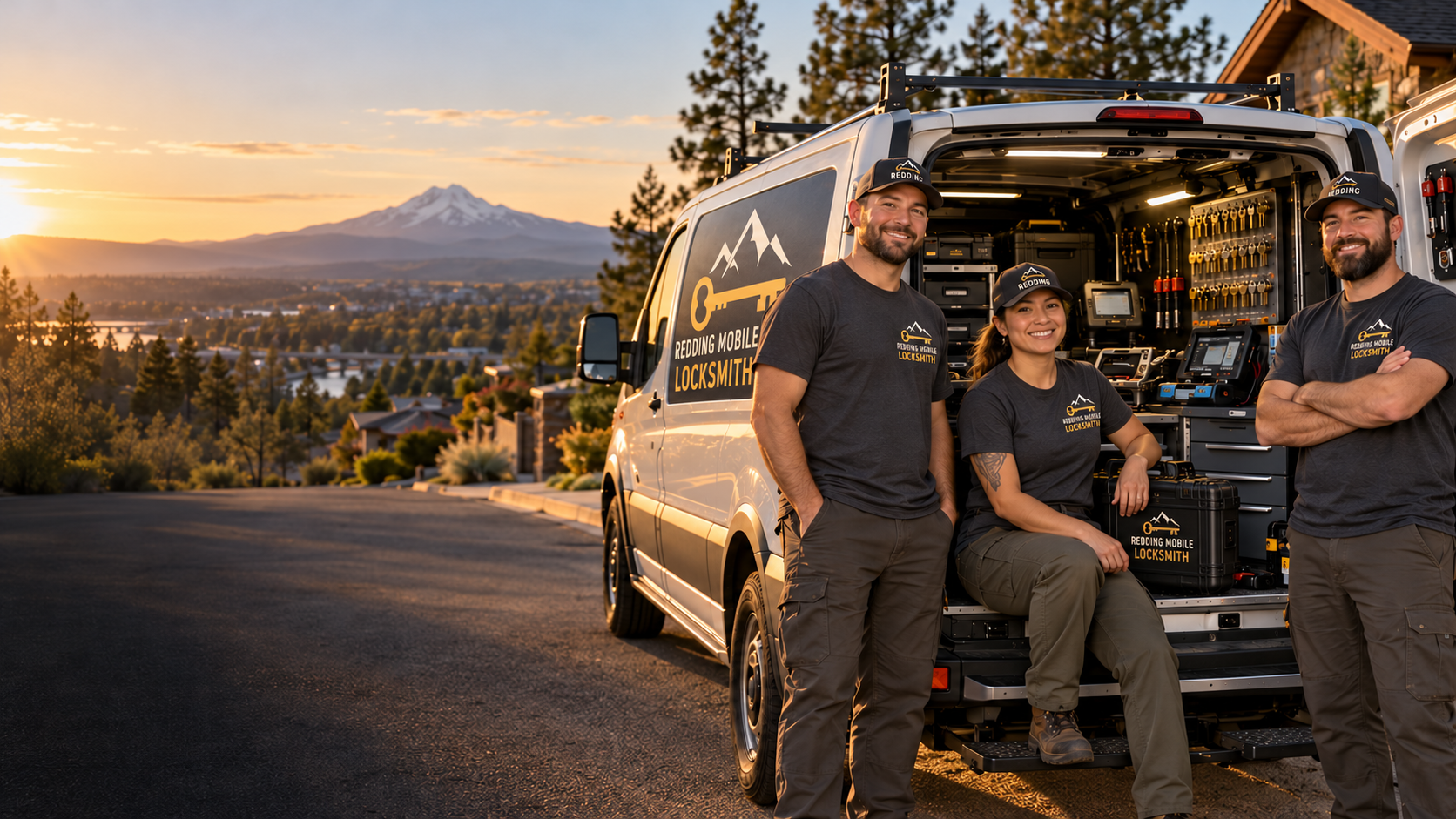
Our crew works from a branded service van, in uniform, with key cutting and programming equipment and common hardware. Because the van is the workshop, a gate padlock, a broken key and a shop door latch can all be dealt with in one visit instead of three separate trips. The rest of this page covers the situations that come up on country property.
A good way to think about country lock work is in layers. The outer layer is the gate and the driveway. The middle layer is the outbuildings, the shop and the equipment. The inner layer is the house and the vehicles. Each layer has its own failure modes, and a weakness in one often hides inside the habits that grew up around it.
Gates, chains and the long driveway
Gates are the first lock a visitor meets. A swing gate with a chain and padlock, a sliding gate on a track, a pipe gate hung on a post. Each relies on a lock that has to withstand sun, dust, rain and the occasional truck bumper.
The failures are predictable. A padlock keyway fills with grit and the key turns hard, then not at all. A shackle rusts. A latch bar sags and the bolt no longer reaches the catch. A chain gets cut and replaced with something that looks the same but is much weaker. In each case the lock is the symptom, and the fix involves looking at the whole setup.
Good gate security starts with hardware that suits the job: a padlock with a shrouded shackle, a hasp that hides the fasteners and a post that does not wobble. Our field notes on gates and padlocks on rural property and gate and fence latch security cover the details.
Sliding gates add their own wrinkles. The latch often relies on a pin or a slide bolt that engages a keeper on a post. If the post leans, even slightly, the bolt can miss. A padlock then ends up carrying the load that the latch was supposed to carry, and it fails sooner than it should. Straightening the post and adjusting the latch can solve what looks like a bad lock.
When you replace a gate padlock, consider buying two or three of the same model keyed alike. That way a single key opens the gate, the barn and the shop, and you are not hunting through a ring of near identical keys at the end of a long day. Keyed alike sets are among the most practical purchases a rural property owner can make.
Shops, barns and the equipment inside
Many Cottonwood properties have a shop or barn that holds tools, tractors, feed, vehicles and supplies. These buildings often have a mix of doors: a personal door with a deadbolt, a big rolling or sliding door with a hasp, and perhaps an old lock nobody remembers installing.
Start by listing every door, every lock and every key. You may find that three buildings use three different keys, and that one lock has no key at all because it was lost years ago. A locksmith can rekey several locks to share a key, replace the ones that are beyond saving and add a better door lock where the existing one is weak.
For specifics on this kind of work, read barn, shop and outbuilding locks, and storage unit and shop padlocks. When you are ready to make changes to a group of locks, rekeying in Cottonwood explains the approach.
Think about who needs access and when. A hired hand may need the barn but not the house. A contractor may need the shop for a week. A neighbor who feeds animals while you travel needs one gate and nothing else. A simple key plan, written down, matches keys to doors so that access ends when the job does.
The ranch house and its doors
The main house on a Cottonwood property is often older, built in stages, with a front door that nobody uses and a side door that everyone does. The side door takes the abuse: muddy boots, dogs, groceries, hay, deliveries. The lock on that door wears fastest, and its key becomes the one most likely to fail.
A common pattern is a deadbolt that works if you hold the door just so. People adapt, and over time the adaptation becomes habit, until the day a guest, a farrier or a delivery driver cannot get it to work. That is a signal to look at the strike plate, the hinges and the cylinder before the lock quits entirely.
If you are locked out, read house lockout service to see how we handle it, and then house lockout in Cottonwood for the local version. A calm approach beats a pry bar, and usually saves the door.
It is worth keeping an eye on the small things as well: a loose door handle, a latch that does not click, a screen door whose lock was never installed. They are easy to ignore and easy to fix, and they are often the first places a casual intruder tests.
Trucks, tractors and work vehicles
Out here, vehicles are tools. Trucks, utility vehicles, trailers and equipment all have keys, and they get dropped in fields, washed in the pocket of a coverall or left in the wrong jacket. Newer trucks use transponder keys or push button start systems that need programming when a key is replaced. Older ones may have simple mechanical keys that a locksmith can cut from a code or by hand.
If you lose the only key, you need a way to get a new one made without towing the vehicle. Mobile key cutting and programming is built for this. We carry equipment on the van so the work can be done where the vehicle sits. Read about work trucks and toolbox locks for more on securing equipment that rides with you.
When a truck is locked with the key inside, a locksmith opens it without damaging the door or window. See car lockout in Cottonwood and car key replacement in Cottonwood for local detail. If a child or animal is locked inside, call emergency services first.
For trucks and equipment that stay parked outdoors, the key is only part of the story. A steering wheel lock that sticks, an ignition cylinder that has loosened, a door lock actuator that clicks but does not move, and a fob that works only when it is held at an odd angle all point to wear, and wear tends to arrive at the worst time.
Securing property when you are away
Rural property owners travel, and the farther the house is from a neighbor, the more the locks matter while you are gone. A well chosen deadbolt, a solid strike plate and a door frame that is not cracked make a difference. So does a lock you actually use. A deadbolt left open because the key is hard to turn does nothing for you.
Simple habits help. Lock the shop, even when you are working nearby. Do not leave a spare key in an obvious spot. Keep a record of who has copies. If a hired hand or a contractor has had access, consider changing the lock when the job is done.
Our guide on locking up before holiday travel offers a checklist, and a home security walkthrough: lock edition helps you inspect the property before you go.
If you are leaving for a longer trip, consider asking a trusted person to look in, and give them a key they can use without having to come to you. Make sure that key works before you leave, and not on the day you need it.
Heat, dust and dry hardware
Summers in this part of the valley are hot and dry, and a lock that sits outdoors takes the full dose. Metal parts grow slightly in the sun. Dust works into the cylinder. Lubricants turn gummy or dry out. The result is a padlock that worked in spring and refuses to open in July.
Maintenance is simple but often skipped. Clean the keyway with compressed air. Apply a dry lubricant made for locks. Check that the shackle moves freely. Replace a lock that has begun to bind rather than forcing it, because forcing the key is how it snaps off in the cylinder.
If that has already happened, do not try to dig the broken piece out yourself with a pin or a nail. Read a broken key in the lock: what to do and what to avoid first. For general upkeep, see lock lubricants: what helps and what hurts.
Moisture is the quieter enemy of country locks. Irrigation spray, morning dew and rain can all reach outdoor cylinders. A cap or cover over a padlock keyway keeps water and dust out. It is a small addition that adds years of life to a lock.
When a lock needs repair, not replacement
There is a strong temptation to replace anything that sticks. Sometimes that is right. Often, a repair is better: a worn latch swapped, a cylinder cleaned and refitted, a strike plate moved a fraction of an inch, a hinge tightened. The goal is to restore reliable operation, not to sell hardware.
We look at the key first. If the key is worn, copies made from it will also be worn, and the problem multiplies. Cutting a fresh key from the code or from a better original often solves what looks like a lock problem.
Our page on lock repair in Cottonwood explains what we check, and the general lock repair service page covers the topic. If the hardware is truly finished, lock installation is the next step.
Repair work also gives us a chance to explain what we found. Many people only learn what their lock was doing wrong when the part is in the locksmith's palm. We are glad to show you the worn pin, the bent spring or the burr on the key and to explain how it led to your trouble.
Businesses in and around Cottonwood
Beyond ranches, Cottonwood has small businesses: shops, service companies, offices and operations that serve the farm and ranch community. These have the same lock needs as any commercial site, plus a few extras, such as yard gates, container storage and vehicle bays.
Common jobs are rekeying after staff changes, repairing an exterior door that has seen heavy use, setting up a master key system for several buildings and fitting hardware that suits the door. Where exits are involved, we explain how the hardware works, and the owner should confirm what rules apply to their building.
More detail is on the commercial locksmith page for Cottonwood and on the commercial locksmith service page.
Business owners in the area often juggle keys across a house, an office and a yard. Consolidating those keys into a clear set, with a record of who holds what, is a quiet improvement that pays back every time someone loses a key or leaves a job.
All six Cottonwood service pages
We keep six dedicated pages for Cottonwood. Car lockout and house lockout handle the locked out situations. Rekeying and lock repair deal with locks that need to change or be fixed.
Car key replacement covers keys and fobs, and commercial locksmith work serves local businesses. Each page is written from its own angle, so you can read the ones that match your problem without wading through repeated text.
For a broader look at everything we do, visit the services page.
A short note on records: after any job, ask for a clear explanation of what was done and keep your key and receipt together. If you later add a lock, rekey a door or replace a key, that history helps the next person who works on it.
How to ask for help and who we serve nearby
The phone line is coming soon. For now, the request form on the contact page is the way to reach us. Tell us the road or landmark, whether there is a gate, what kind of lock or vehicle is involved and what has happened. Directions that include a gate code or a landmark save time.
We also serve Anderson to the north, the larger city of Redding beyond it and Shasta Lake near the dam. If your property sits between communities, we will work out the right route with you.
Before any work, the crew explains the plan and confirms you have authority over the property or vehicle. Afterward, we test the lock with you present, so you can see it work before we leave.
Common questions
Can you come to a property with a locked gate?
Yes. Tell us how to get through the gate when you send your request, whether by a code, a person on site or another arrangement. If the gate lock itself is the problem, we can often work on it directly. Give us a landmark or road description so the crew can find the entrance.
Can you key several buildings to the same key?
In many cases, yes. If the locks are a type that can be rekeyed, we can set them to share a key, so one key opens the house, the shop and the gate. Some locks may need replacing first, and we will tell you what applies. You can also keep some doors separate.
My padlock key snapped off. What should I do?
Stop turning the key and do not try to dig it out with a pin, which can push the piece deeper. Keep the broken parts if you can. A locksmith can usually remove the fragment with proper extraction tools and then cut a new key or replace the lock if it is worn.
Can you make a key for a truck or tractor on site?
For many vehicles, yes. The van carries key cutting and programming equipment. Some machines use simple mechanical keys, others use transponder chips. Tell us the make, model and year and where the vehicle is located, and we will explain what the job involves before starting.
Do you only work on residential properties out there?
No. We serve homes, ranch buildings, shops and businesses in the Cottonwood area. Commercial work can include storefront locks, office doors, yard gates and equipment buildings. Describe the property and the problem in your request so we can bring appropriate tools and hardware.
How do I contact you if the phone is not live?
The call line is coming soon. Use the request form on our contact page, and include the road or landmark, the type of lock or vehicle and a short note on what happened. If someone is in danger or hurt, call emergency services before submitting a request.