
Home / Services
Our twelve services
Twelve locksmith services, and how to choose between them
Every problem with a lock or a key falls under one of twelve services. This page explains each one in a sentence or two, shows how they overlap and helps you decide which to ask for.
How the twelve services are arranged
Alpine Dispatch groups its work in two layers. The first layer is about setting: the 24 hour emergency service, automotive work, residential work and commercial work. The second layer is about the job itself: lockouts, key replacement, programming, rekeying, repair, installation and door hardware. A real problem usually has a place in both layers, and you only need to name one of them to get started.
Think of it as a map with two axes. If you tell us "my car," that puts you in the automotive setting, and the crew will narrow down from there. If you tell us "I changed the locks last week and one sticks," that points to residential repair. Either way, the starting point is simply what happened, in plain words.
Nothing on this page replaces that conversation. It exists so you can walk into the conversation knowing the vocabulary and what each service involves. The pages linked below go much deeper on every item, and each one explains what the technician does, what you can prepare and what questions are worth asking.
A word on naming. We chose plain names for the services because we would rather you recognize your own problem than decode our vocabulary. "Rekeying" is the one term that sometimes needs a sentence of explanation: it means changing the pins inside a lock so a different key works, without removing the lock from the door. Everything else on the list says what it does.
The four service settings
The 24 hour emergency locksmith page covers the around the clock side of the crew: how the dispatch conversation goes, what the technician needs from you and what to do while you wait. Choose it when the timing is the whole point, such as a late night lockout or a door that will not secure.
Automotive locksmith work covers cars, trucks and the keys that start them. It explains how a mobile technician works at the curb or in a driveway, what equipment the van carries and where the limits are for certain vehicles.
Residential locksmith work treats a home as a system of cylinders, deadbolts, strikes, frames and keys. Commercial locksmith work covers key control and door hardware for shops, offices and small properties. Pick the setting that matches the building you are standing at.
The settings also shape what the technician brings. A residential call often means cylinders, deadbolts and strike plates in common sizes. A commercial call may involve closers, exit devices and keyed systems that cover many doors. An automotive call means cutting and programming equipment. Knowing the setting early lets the crew load the van sensibly before leaving, which saves you time at the door.
The eight specific jobs
The eight job pages are where the practical detail lives. Car lockout and house lockout describe what happens when you cannot get into a vehicle or a home. Car key replacement and key programming cover cutting a new key and teaching the vehicle to accept it.
Rekeying changes the inside of a lock so old keys stop working without replacing the hardware. Lock repair fixes a lock that sticks, jams, drags or no longer latches. Lock installation fits new hardware, such as a deadbolt on a door that had none.
Finally, commercial door hardware covers closers, exit devices, strikes and similar parts that make a business door work every day. Each of these jobs can stand alone or combine with another on the same visit.
It helps to know what each job is not. A lockout is about getting in without harming the lock or the door, and it does not change any keys. Rekeying changes keys but leaves the hardware in place. Repair restores a part that has worn or bent. Installation adds something new. Keeping those boundaries clear makes it easier to describe your problem and easier to understand what the technician tells you.
Which service for which problem
People sometimes worry that they will pick the wrong service and cause a delay. They will not. The request form has room for an open description, and the crew reads it for meaning, not for the correct keyword. A message like "my deadbolt turns but the door still opens" tells a technician everything needed to bring the right parts.
A simple way to choose is to start from what you can see or feel. If you cannot get in, it is a lockout. If you can get in but the key is gone, it is key replacement. If the key is fine but a lock fights you, it is repair. If everything works but you worry who else has a key, it is rekeying.
Here are common situations and the service they usually point to:
Most calls fit one of those patterns. When yours straddles two, say so. A good dispatcher would rather hear the whole story than guess at a category.
Another useful test is to ask what you want to be true when the visit ends. If the answer is "I want to be inside," you need a lockout. If it is "I want to start my car," you need a key. If it is "I want only my family to hold keys," you need rekeying. If it is "I want this door to close properly," you need repair or hardware. Naming the finish line usually reveals the service.
- Keys left inside a parked car point to car lockout.
- A front door that closed behind you with no key in your pocket points to house lockout.
- A lost transponder key points to car key replacement and often key programming.
- A new home where you do not know who holds keys points to rekeying.
- A deadbolt that turns hard or half way points to lock repair.
Where services overlap
Overlap is one reason we avoid fixed packages. Real locks do not arrive in tidy bundles, and a rigid list of what is included would force you to pay attention to our categories instead of your door. The crew would rather look at what is actually wrong and describe the work honestly, one task at a time, so nothing is added that you did not need.
The twelve services are not sealed boxes. A car key replacement nearly always involves key programming, because a modern key is not working until the vehicle accepts it. A house lockout may end with lock repair if a cylinder was already failing, and a rekeying visit may turn into lock installation when a door turns out to have no deadbolt at all.
We encourage you to mention these possibilities up front. If you tell the crew that a deadbolt has been sticking for weeks and then you get locked out, that history helps the technician bring the right parts. Likewise, if a business is rekeying doors and also wants closers adjusted, one visit can cover both.
Overlap also affects planning. A visit with several tasks takes more preparation than a single one, and the crew can only prepare if they know. Our rekeying or replacing decision walk through is a good example of a guide that clarifies where one service ends and another begins.
What every visit has in common
There is also a rhythm to a good visit. First comes the conversation, where the technician confirms what you told dispatch. Next comes a look at the lock or key. Then the plan is explained, the work is done, and the technician tests it before leaving, turning the key, trying the latch and checking that everything operates as it should. That sequence repeats whether the job is a car door or a storeroom.
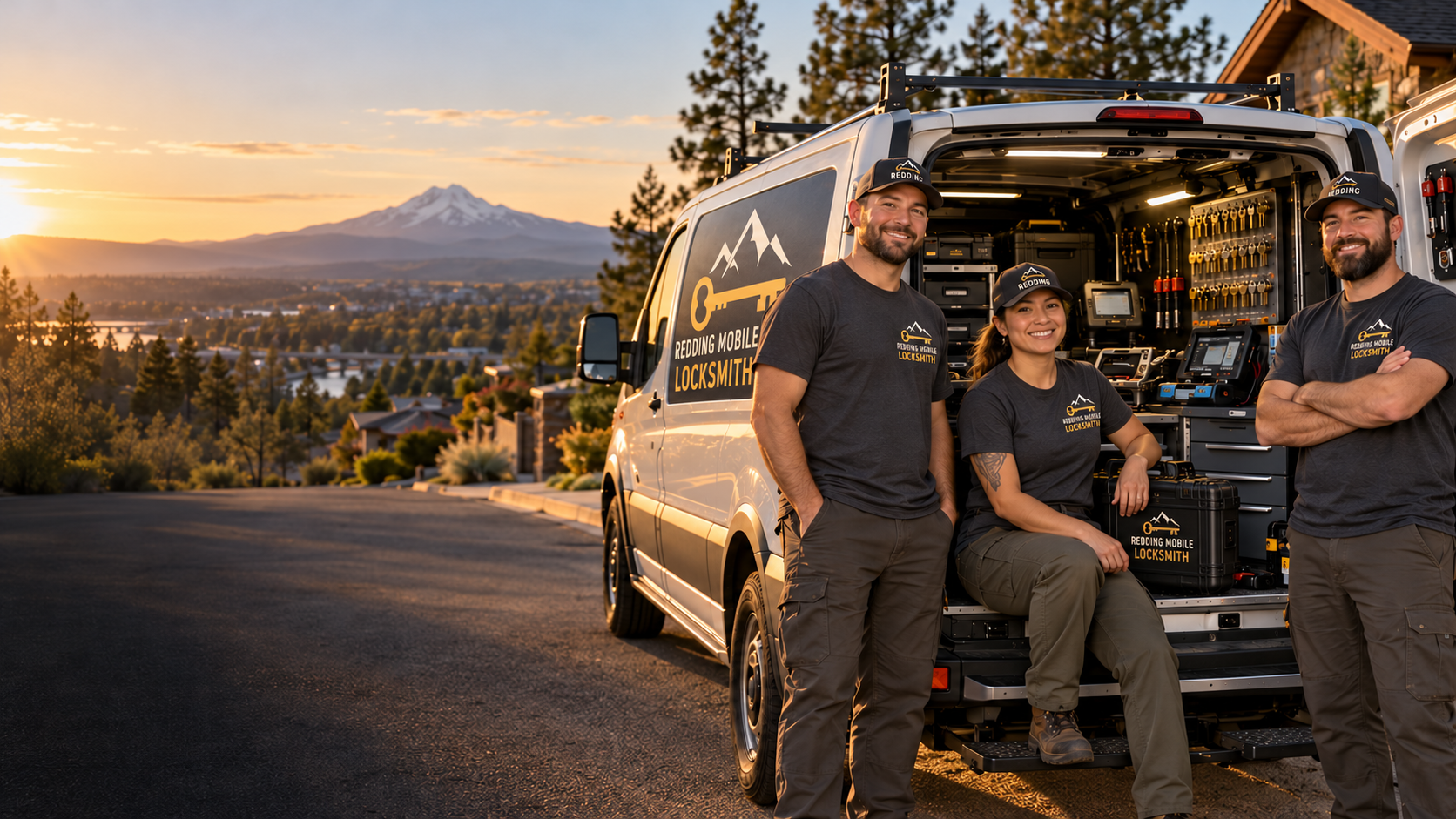
Whatever service you pick, a few things stay constant. The crew arrives in uniforms with a branded service van, so you can see who is arriving before opening a door. The van carries professional tools, key cutting and programming equipment, and common hardware, so many jobs finish on the spot.
The technician will explain what they plan to do before they do it, and will tell you if the job turns out to need something different. They will also ask you to show that you are entitled to open the lock, whether that is a car, a house or a business door. This is a normal part of responsible locksmith work and protects the people who own the property.
You can speed everything along by having a few things ready. Gather identification, think about how you can show a connection to the vehicle or building, and be ready to describe the lock, the door or the car. The guide to what to gather when you have lost every key lists these items in more detail.
Services for vehicles
Picture a pickup parked at a trailhead on a cold evening, keys sitting on the driver's seat. That is a lockout, and it is a different problem from a pickup whose only key snapped off in the ignition. The first calls for entry without damage. The second calls for extraction and a new key. Knowing which one you have lets the crew prepare correctly, and our service pages treat them separately for that reason.
Vehicle work is a large share of what a mobile locksmith does, because cars and trucks go wherever their owners go and their locks fail in parking lots rather than workshops. Lockouts, lost keys, broken keys, worn ignitions and dead fobs all land here, and the equipment in the van is aimed squarely at them.
Modern keys deserve a short explanation. A transponder key holds a small chip that answers a question from the vehicle, and a smart key lets the vehicle sense a fob nearby. Each type needs different tools to replace. Our guides to car key types in plain words, transponder keys and smart keys and push button start unpack the differences.
If a child or pet is inside a locked vehicle, do not wait for a locksmith. Call emergency services first. Our short guide on a child or pet locked in a vehicle explains why and what to say to the dispatcher.
Services for homes and businesses
For homes, the services revolve around keeping the right people in and the wrong people out. That covers getting back inside after a lockout, changing keys after a move, fixing a lock that struggles and installing hardware where a door is weak. The guide to a home security walkthrough, lock edition is a useful companion if you are not sure where to start.
For businesses, the emphasis is on key control and daily durability. A door that sticks in a busy shop wastes time every hour it stays that way, and a key that nobody can account for is a risk. Closers, exit devices and strikes all need to work together. The guide to panic hardware basics for stores shows how one common piece of exit hardware works.
We do not give legal advice, and we do not state codes or permit rules as fact. If a door has to meet a rule, such as an exit requirement, check with your local authority or property insurer, then share what you learn with the technician.
Whatever the setting, the same honesty applies. If a particular home or business needs a trade other than a locksmith, such as a carpenter for a badly warped door frame, the crew will say so instead of selling hardware that cannot solve the problem. A lock is only as good as the door it sits in, and sometimes the right answer is to fix the frame first.
How service reaches you across two counties
Alpine Dispatch serves 17 communities across Shasta and Siskiyou Counties, from Redding and Anderson to Mount Shasta, Yreka and Etna. Every community has its own page on the service areas page, where ZIP codes and local context are laid out by corridor.
Travel across that much ground changes how a visit is planned. The crew needs to know your exact location, the condition of the road in winter and whether you are in a spot that is safe to wait. Mountain passes and rural roads can complicate the trip, which is why we ask for clear details on the request form rather than only a town name.
When you are ready, use the request form on the contact page. Our phone line is coming soon, so the form is the way to reach the crew for now. If you would like to understand the team behind the work first, read the about page.
Weather matters here more than in many regions. The valley communities, including Redding, Anderson and Cottonwood, deal with long hot dry summers that stress lubricants and electronics. The mountain communities, including Mount Shasta, Dunsmuir and McCloud, deal with snow, ice and hard cold. We keep both in mind when we describe how each service works.
Learning more before you need us
The right time to read about locks is before one fails. Our field notes library holds 70 guides organized around real situations, from how a pin tumbler works to how to store spare keys safely. Browse the full set on the field notes page, or start with a few that match the services above.
If you are thinking about changing a lock, try cylinder types in simple terms. If you want to understand why a duplicate key sometimes fails, read why duplicate keys sometimes fail. If you keep spares, storing spare keys safely is a short, practical read.
Reading ahead also helps you spot a trustworthy professional. When a technician explains a choice in terms you recognize from a guide, you can ask better questions and make a calmer decision.
Common questions
How many services does Alpine Dispatch offer?
We offer twelve services: four broad settings (emergency, automotive, residential and commercial) and eight specific jobs (car lockout, house lockout, car key replacement, key programming, rekeying, lock repair, lock installation and commercial door hardware). Many visits combine more than one.
What if my problem fits more than one service?
That is common, and it is fine. Describe what happened and the crew will work out which services apply. For example, a lost transponder key usually involves both key replacement and programming. Mentioning the full story up front helps the technician bring the right equipment.
Do you publish prices for each service?
No. The right figure depends on the lock, the vehicle and the situation, and a number on a web page would only be a guess. The crew explains what the job involves before starting, so you know what to expect from the visit.
Can one visit cover several services?
Often yes. A technician can rekey several doors, repair one stiff lock and install a new deadbolt in a single trip if the crew knows ahead of time. Listing everything you need on the request form lets the crew prepare hardware and tools.
How do I request any of these services?
Use the request form on the contact page and describe what happened, where you are and what lock, door or vehicle is involved. Our phone line is coming soon, so the form is the way to reach the crew for now.
Do all twelve services run around the clock?
Alpine Dispatch is a 24 hour mobile locksmith, and the crew is available at any hour. Some work, such as planned installations, is often easier to arrange in advance, but emergencies like lockouts and broken locks are handled whenever they happen.