
Home / Services / 24 Hour Emergency Locksmith
Around the clock help
24 hour emergency locksmith service for the North State
When a lock fails at midnight, the call itself is the first piece of help. This page walks through what an around the clock dispatch conversation sounds like and what our technician needs from you.
What counts as a locksmith emergency
Not every lock problem is an emergency, and it helps to know the difference. A key that sticks a little on Tuesday afternoon can wait until you can plan a repair. A door that will not lock behind you at midnight cannot. A vehicle with the keys inside on a cold mountain pullout cannot. Emergencies are the problems where waiting leaves a person, a home or a business exposed or stranded.
Typical examples include being locked out of a house, locked out of a vehicle in a remote or unsafe spot, a key broken off in a lock you need to use tonight, a door damaged so it no longer secures, and a business that cannot close up. The 24 hour service exists for exactly those moments.
It also covers the quieter emergencies, like discovering that keys were stolen along with a wallet, and wanting the locks changed before evening. If you are not sure whether your situation qualifies, describe it anyway. The dispatcher will help you sort it out.
Timing matters in a different way too. Some emergencies get worse the longer they run: a door that will not lock leaves a household exposed all night, and a vehicle left unlocked at a trailhead invites trouble. Others are only urgent because of where you are standing. Being clear about which kind you have helps the crew set priorities and tell you honestly what to expect.
The shape of the dispatch conversation
Our dispatch conversation follows a steady order, like a good dispatcher talking you through a bad moment. First comes safety: are you somewhere safe, and is anyone in danger? Then location: where exactly are you? Then the problem: what are you locked out of, and what happened? Finally, the details that let a technician plan: what kind of lock, what kind of vehicle, and what you need at the end.
The order is deliberate. Safety comes first because a lock problem can be solved later but a person's wellbeing cannot. If anyone is in danger, including a child or a pet shut inside a vehicle, the answer is emergency services first. We say that clearly so nobody loses time. Our guide on a child or pet locked in a vehicle explains why.
Location comes second because everything else depends on it. You can be calm and clear about the problem, but if the crew cannot find you, nothing happens. The more specific you can be, the better the trip goes, and we will walk you through ways to describe your position even when you are somewhere unfamiliar.
Expect the dispatcher to repeat things back to you. That is not slowness; it is how mistakes are caught. A swapped digit in a route number, a misheard town name or an unclear gate description can send a van the wrong way, so the repeat is a safety check. If anything sounds wrong, correct it immediately.
Describing where you are
People are often surprised how hard it is to explain a location when they are stressed. Landmarks help: a highway number, a nearby exit, a business you can see, a gate, a mailbox, a distinctive building or a bend in the road. In rural areas, describe the road and the direction you came from. In towns, name the nearest cross street or the type of building.
In our territory, many calls begin along Interstate 5, Highway 299, Highway 44, Highway 89 or Highway 97, or at trailheads, lake access points and ranch gates where no street address exists. Say which highway you were on, which direction you were traveling and what you passed last. If you cannot tell, a phone map pin or the photo location on your device can be read to the dispatcher.
We do not publish travel times because they depend on weather, road conditions and where the crew is working. What we can promise is honesty: when you contact us we will tell you plainly what we know about getting to you. Our service areas page shows every community we cover.
Cell coverage can be thin in canyons, along the lake and on mountain roads. If your signal is weak, send the request form while you still have a connection and put your location at the top. If you lose signal afterward, stay put unless you are in danger, because moving makes you harder to find. A technician can only reach the place you described, so keep that description accurate.
What the technician needs from you
Once the technician is assigned, a few details make the visit go smoothly. For a home, they need to know the type of door, whether there is a deadbolt, whether a lock is damaged and whether anyone is inside. For a vehicle, they need the make, model and approximate age, and whether the keys are inside or lost. For a business, they need to know what kind of door and whether it has a closer or exit hardware.
They will also ask about proof. A responsible locksmith confirms that you are entitled to open a lock before doing it. For a vehicle, that often means identification plus something connecting you to the car, such as registration or insurance documents that you can reach. For a home, it may mean identification showing your address, or something that shows you live or rent there.
If you cannot reach those documents because they are locked inside, say so. The technician will explain the options. The guide to what to gather when you have lost every key lists the most useful items and ways to show a connection when paperwork is out of reach.
It also helps to say what you want at the end. Some people only need the door open. Others want a broken lock replaced so the building is secure tonight, a spare key made while the van is there, or the locks changed because keys went missing. Saying so up front lets the technician bring the right parts and avoid a second trip.
What the crew brings
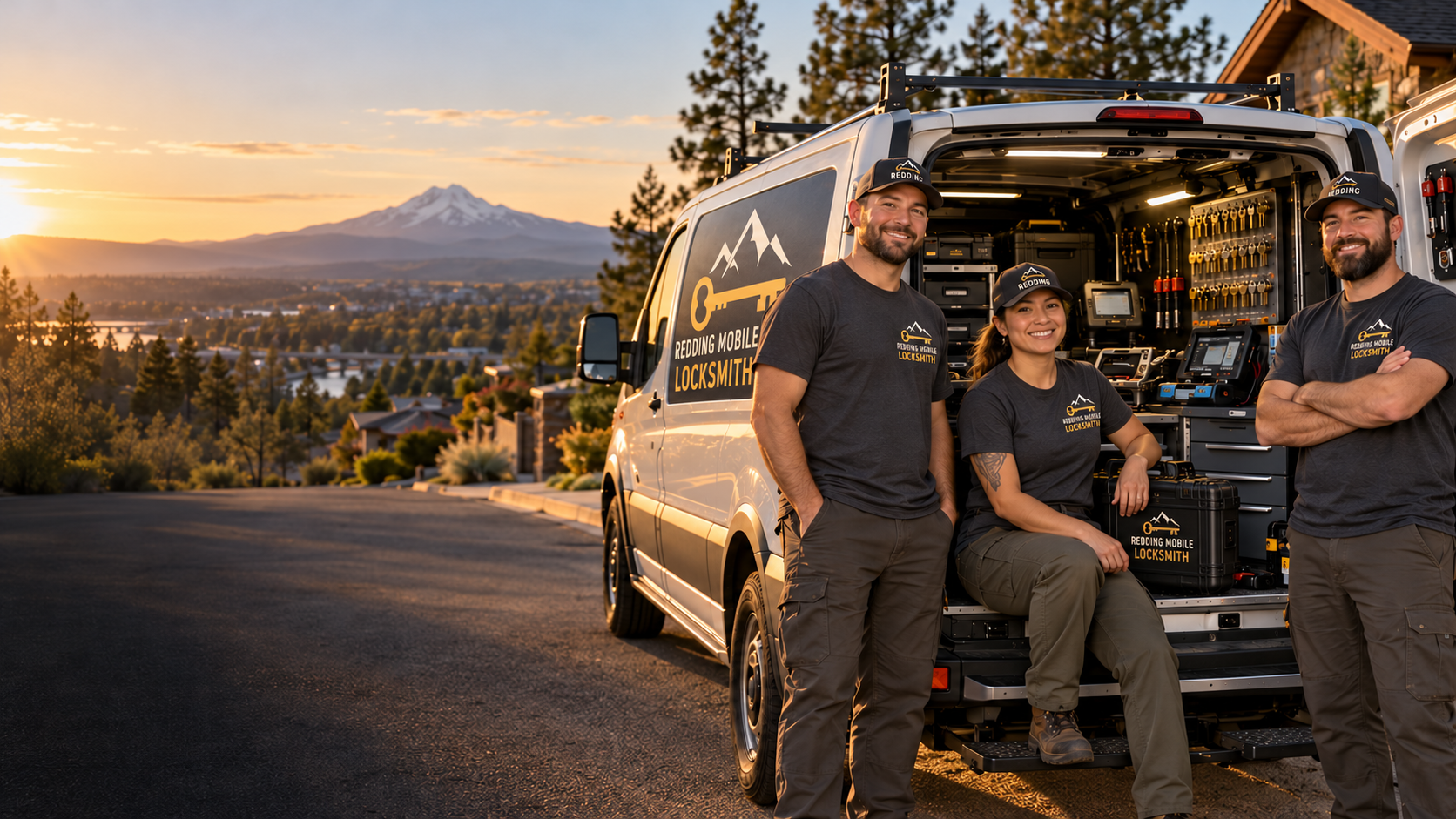
The crew arrives in uniforms and drives a branded service van, so you can see who is arriving before you open a door or step out of a vehicle. The van carries professional tools, key cutting and programming equipment, and common hardware. That means many problems can be solved at the door, curb or driveway where they began.
The point of a mobile service is that you should not have to go anywhere. If you are stuck outside a car on a dark road, the equipment comes to you. If you are in front of a shop door at closing time, the technician works there. The only things the crew cannot always bring are parts for unusual locks or very new vehicles, and they will tell you if that is the case.
For more on what a vehicle visit looks like in practice, see automotive locksmith. For home visits, see residential locksmith, and for businesses, commercial locksmith.
A word on method. The goal of any emergency entry is to open the lock without harming the door, the frame or the vehicle wherever that is possible. We do not describe the techniques here, because instructions that help a locksmith would also help a burglar. What matters to you is the result: the lock works afterward, and the property is as secure as it was before.
Staying safe while you wait
Waiting is the part nobody talks about. If you are stranded, stay somewhere you feel safe. A lit area near other people is better than a dark road. If you are in a vehicle on a roadside, think about your hazard lights and whether it is safer to wait inside the car or away from traffic. In cold weather, keep warm; in hot weather, stay shaded and hydrated.
If you are at a home and the door has failed, stay in a place where you can be seen, such as a porch or driveway, and call someone to be with you if you can. Do not leave a property unsecured if you can avoid it, and do not accept help from strangers who offer to open the door for you.
We take this seriously enough to have written guides about it. For winter, read winter lockouts and frozen locks in the mountains. For preparation, read preventing snow day lockouts.
Confirming who is arriving
Think about what makes you feel safe when someone you do not know comes to your door or your car late at night. Most people want to see a uniform, a marked vehicle and a calm, unhurried manner. They want the person to explain before acting. Those are the expectations we hold ourselves to, and they are fair expectations to hold any service to.
Because you may be alone or after dark, you should be able to confirm who is arriving. Our crew wears uniforms and the vans are branded, which gives you something to check against what the dispatcher told you. When the technician arrives, they will introduce themselves and tell you what they plan to do.
It is reasonable to ask for identification, and it is reasonable to ask the dispatcher what the technician and van will look like when you make contact. Do not hand over keys, documents or access until you are comfortable. A professional will not mind the caution and will usually welcome it.
We say all this because scams around emergency locksmith calls are a real concern in many places. Check the van, check the uniform, and trust your instincts. If something feels wrong, you can stop and call the request line again.
Common after hours situations
The hours between dark and dawn change the way people feel about a lockout. Everything seems more urgent, and a small mistake feels large. The crew understands that and talks accordingly, calmly and without drama. A steady voice on the other end of the line is part of the service, and it often matters as much as the tools in the van.
Picture a few typical situations. A parent arrives home late with a sleeping child and discovers the house key is not in the bag. A worker finishes a long shift and finds the car locked with the keys on the seat. A hiker returns from a trail and the keys are in a pack left on the far side of a river. A shop owner pulls the front door shut and hears the latch click without a key in hand.
Each of these situations has a different shape, and the crew treats them differently. A sleeping child makes the door urgent but also quiet. A worker on a long shift needs a calm, steady response. A hiker needs a plan for the keys. A shop owner needs to secure the building properly before leaving.
We have written fuller guides on several of these, including carrying keys while hiking, fishing and boating and key control for a small business at opening and closing.
Think too about the follow up. After an emergency entry, a household often wants to know whether the lock that failed is still trustworthy and whether anyone else could hold a key. That is a good moment to ask about rekeying or a check of the door hardware. The technician is already on site, and the conversation is easier when the problem is fresh.
Before an emergency happens
A little preparation turns many emergencies into small inconveniences. Keep a spare key in a safe, discreet place that is not under the doormat. Give a spare to someone you trust who lives nearby. Take a photo of your key, front and back, and know the make and model of your vehicles. Store the request page of this site on your phone.
The guides on storing spare keys safely and hiding a key outside, and better options go deeper on how to do this without handing a stranger a way in.
Also consider the condition of your locks. A stiff deadbolt or a worn key is a warning, and fixing it in daylight is much easier than fixing it at midnight. Our lock repair service handles exactly that kind of early repair.
How to reach the crew
Please use the request form for real needs and include as much as you can. A short message that says "locked out, Mount Shasta" leaves the crew guessing, while a message that names the road, the type of door and whether anyone is inside lets them plan properly. Detail is the single biggest thing you control, and it shapes how smoothly the whole visit goes.
The request form on the contact page is the way to reach us for now. Tell us where you are, what happened and what you are locked out of, and include whatever detail you have about the lock, door or vehicle. Our phone line is coming soon, and we would rather say so plainly than publish a number that does not work.
When the crew responds, they will confirm the details with you and explain what to expect. They will also tell you honestly if the job looks more involved than it first seemed, so you are never surprised at the door.
If you would like to learn more about the team before you ask, read the about page. And if you want to browse all of our work, the services overview explains how the twelve services fit together.
Common questions
Is Alpine Dispatch really available at any hour?
Yes. We are a 24 hour mobile locksmith, so the crew is available at night, on weekends and on holidays. The request form on the contact page is the way to reach us for now, and a phone line is coming soon.
What should I do first if I am locked out at night?
Get to a safe, visible place and make sure nobody is in danger. If a child or pet is inside a locked vehicle, call emergency services before anything else. Then contact the crew with your exact location and a description of the lock, door or vehicle.
What does the technician need to know?
They need your location, what you are locked out of and a few details such as the type of door or the make and model of the vehicle. They will also ask you to show that you are entitled to open the lock, usually with identification and something that connects you to the property.
Can I tell who is arriving?
Yes. The crew wears uniforms and drives branded service vans. It is reasonable to ask the dispatcher what to look for and to ask the technician for identification when they arrive. A professional will welcome the caution.
Do you give an arrival time?
We do not publish arrival times, because weather, road conditions and where the crew is working all change the trip. When you make contact, the crew will tell you honestly what they know about getting to your location.
What if I cannot reach my documents?
Tell the dispatcher. If your identification or registration is locked inside, the technician will explain the options for showing that you are entitled to open the lock. Having a photo ID in your wallet or on your phone is the simplest preparation.