Emergency lockouts
Help for home, business and vehicle access when you are locked out.
Request help → ReddingMobile Locksmith24 hour dispatchCall line coming soon
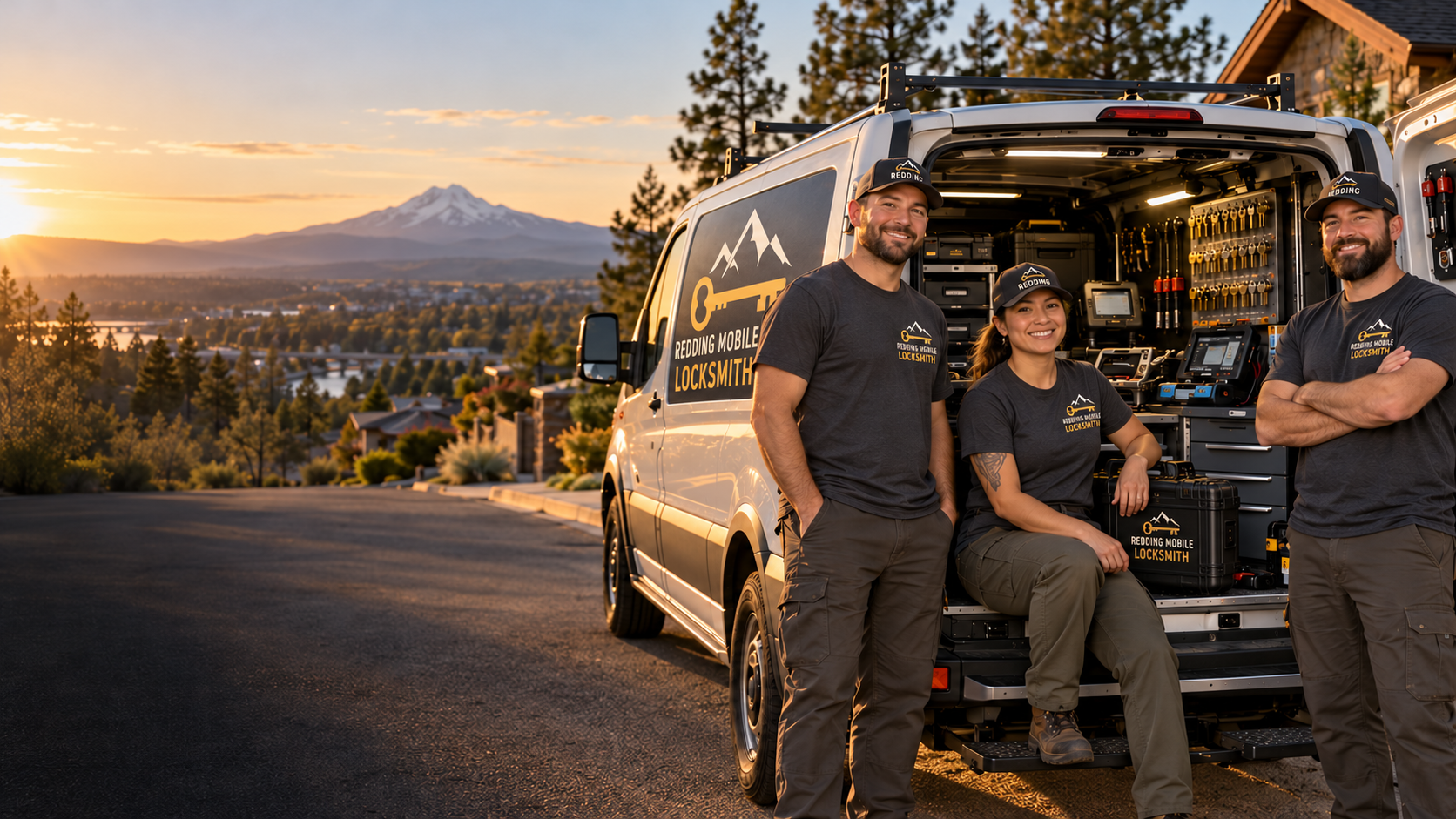
Redding, California | Mobile locksmith service
A properly equipped mobile locksmith team for homes, vehicles and businesses across Shasta and Siskiyou Counties.
Built for the North State
From a late vehicle lockout to a planned commercial rekey, the experience should feel clear from the first call. Our mobile setup keeps professional tools, key equipment and common hardware close at hand.
Start with a short conversation →What we handle
Help for home, business and vehicle access when you are locked out.
Request help →Vehicle entry, replacement keys, key programming and ignition related service.
View automotive →Rekeying, lock changes, repairs and practical upgrades for your home.
View residential →Door hardware, access solutions and rekeying for local businesses.
View commercial →The mobile workshop
Organized tools, modern key equipment and practical hardware help keep the work focused at your location.
Where we travel
Every community we serve, with its ZIP codes.
Cottonwood96022
Anderson96007
Palo Cedro96073
Millville96062
Redding96001, 96002, 96003
Shasta Lake96019, 96079, 96089
Lakehead96051, 96070
Sims96017
Dunsmuir96025
McCloud96057
Mount Shasta96067
Weed96094
Granada96038
Montague96064
Yreka96097
Fort Jones96032
Etna96027
Most lockouts do not happen in a comfortable place. They happen at a gas pump on Interstate 5, in a gravel pullout above a river, in a driveway with a grocery bag melting in your hand, or at a shop door just after closing. A locksmith who waits behind a counter cannot do much about any of that. We built Alpine Dispatch around the opposite idea: the work travels, and the crew arrives with what the job needs.
Our team wears uniforms and drives branded service vans. Each van carries professional tools, key cutting and programming equipment, and common hardware, so a technician can handle most problems at the door, the curb or the driveway where they begin. That matters in a region where the next hardware store can be a long way off and where some of our towns sit well apart from each other.
We say "we" on this site because the work is done by a crew, not a single person. The crew answers the line at any hour, sends the right technician and keeps you informed. We will not dress that up with big promises. What we can offer is plain: show up prepared, explain what we are about to do before we do it, and leave the lock working.
Locks do not fail on a schedule. Keys vanish on a Sunday evening, a deadbolt seizes on a holiday, a car door closes with the keys on the seat at two in the morning. Our 24 hour service exists because those moments are the ones people remember. The dispatch conversation is built to be calm: where are you, what happened, is anyone in danger, and what are you locked out of.
If someone is in danger, the answer is not a locksmith. A child or a pet shut inside a vehicle is an emergency for fire and rescue crews, so call emergency services first and then contact us if a lock still needs attention. Everything else, from a shut door on a cold night to a broken key in a front entry, is exactly what a mobile crew is for.
Our 24 hour emergency locksmith page walks through the whole call in detail, including what the technician will ask you for and what you can have ready while you wait. The more clearly you can describe where you are and what you are locked out of, the better the crew can plan the trip.
We organize our work into twelve services so you can find the one that matches your problem. Four are broad headings: the 24 hour emergency locksmith service, automotive locksmith work, residential locksmith work and commercial locksmith work. Eight are specific jobs: car lockout, house lockout, car key replacement, key programming, rekeying, lock repair, lock installation and commercial door hardware.
The broad headings describe the setting, such as a car, a house or a storefront. The specific jobs describe what is physically done to a lock or a key. Many calls touch several at once. A lost car key might involve a lockout, a replacement and programming. A move into a new house might mean rekeying the old locks and installing a new deadbolt on the garage entry door.
If you are unsure what to call your problem, that is fine. Describe what happened in your own words and the crew will sort out which service it is. The services overview explains how the twelve fit together and how to choose between them when two seem to apply.
Alpine Dispatch serves 17 communities across two counties. In Shasta County that means Redding (ZIP codes 96001, 96002 and 96003), Anderson (96007), Shasta Lake (96019, 96079 and 96089), Cottonwood (96022), Palo Cedro (96073), Millville (96062), Lakehead (96051 and 96070) and Sims (96017).
In Siskiyou County the list runs north along the Interstate 5 corridor and beyond: Mount Shasta (96067), Yreka (96097), Dunsmuir (96025), McCloud (96057), Weed (96094), Granada (96038), Montague (96064), Fort Jones (96032) and Etna (96027).
Each community has its own page on this site, written around what locksmith needs look like there: housing, weather, travel and local businesses in general terms. The full set lives on the service areas page, which also groups the towns by corridor so you can see how they connect along Interstate 5, Highway 299, Highway 44, Highway 89 and Highway 97.
Distance shapes how we think about the work. Some of our communities sit close together along Interstate 5, while others, such as Etna and Fort Jones in the Scott Valley or Lakehead on the arm of Lake Shasta, take real planning to reach. We would rather tell you that plainly when you ask than let you sit waiting on an optimistic guess. Clear location details from you make that planning far more accurate.
The North State has two very different climates, and locks feel both. In the valley around Redding, Anderson and Cottonwood, summers are hot and dry. Heat expands metal, dries out grease and bakes dust into keyways, so a lock that turned easily in April can feel gritty by August. Car interiors get hot enough to warp plastic key fobs and drain their batteries sooner than you would expect.
Up in the mountain towns, the problem flips. Mount Shasta, Dunsmuir, McCloud and Weed see snow and hard cold. Moisture finds its way into a cylinder, freezes and turns a working deadbolt into a block of ice. Door seals harden and shrink, frames move a little with the seasons and a latch that lined up in July may rub in January.
None of this is mysterious, and a lot of it is preventable. Our guide to winter lockouts and frozen locks and the one on why locks stick in hot summer weather explain the mechanics and the small habits that keep a lock healthy through both extremes.
A few habits in every season make the biggest difference. Keep a spare key somewhere safe that is not the car or the house itself, test a stiff lock early instead of forcing it, and replace worn keys before they snap. A worn key is a quiet warning, and our guide on what happens when a key wears down shows how to spot the signs before a bad day arrives.
This is a driving region. People commute between Redding and Anderson, haul trailers to Lake Shasta, drive to trailheads near Mount Shasta, cross the mountains on Highway 299 and run work trucks up Highway 97. That means a large share of our calls involve vehicles, and vehicle keys have changed a great deal in a short time.
An older car may use a plain cut metal key. A newer one almost always has a transponder chip inside the key head that has to talk to the engine computer before the car will start. Many current vehicles go further, with smart keys that never touch an ignition at all. Our plain words guide to car key types and the explainer on transponder keys cover the differences without jargon.
Because the van carries key cutting and programming equipment, a technician can often make and program a key at your location instead of sending you to a dealer. Whether that is possible depends on the vehicle, and the crew will tell you honestly if a particular job needs something else. For lockouts, see our car lockout service, and for the keys themselves, see car key replacement.
Anglers, hikers and boaters add their own twist, because keys get lost in water, wedged in rocks or left in a jacket back at the trailhead. If your outdoor routine is hard on keys, the guide on carrying keys while hiking, fishing and boating has practical ideas that cost almost nothing. A spare stored safely beats any rescue after the fact, and it keeps a good day outside from turning into a long wait beside a locked truck.
Residential work is more varied than people expect. A family may need a house lockout resolved, a landlord may need every unit rekeyed between tenants, and a couple who just bought a place may want to be sure no stranger still holds a working key. Rural properties add gates, barns, workshops and outbuildings that each need their own thinking.
A home is a system, not a single lock. The cylinder, the deadbolt, the strike plate, the door and the frame all share the load, and a weak link anywhere defeats the rest. The residential locksmith page explains that system, and guides such as choosing a deadbolt grade in plain words and strike plates and door frames go deeper.
For second homes and lake properties the stakes are different, because nobody is there to notice a problem. Our guides on lock strategy for cabins and second homes and securing a vacation rental cover the routines that keep a quiet property secure.
Barns, shops and gates deserve a mention of their own, because rural property often relies on padlocks and simple latches that see weather every day. Rust, dust and hay chaff are hard on small mechanisms. Our guides on gates and padlocks on rural property and barn, shop and outbuilding locks explain which choices hold up outdoors and which look sturdy but fail after a single wet season.
Business locks carry a heavier job than household ones. They get used dozens of times a day, by people who come and go, and they have to satisfy practical needs such as exit hardware for a customer door or separate access for a back office. The key question is control: who holds a key, which doors it opens and what happens when someone leaves.
Our commercial locksmith work covers that thinking, and commercial door hardware covers the physical parts, including closers, exit devices and strikes. We deliberately describe general principles instead of promising specific systems, because the right answer depends on the building and the way the business runs.
If you manage a small shop, a restaurant or a hall, start with the guide to key control at opening and closing. It explains the habits that prevent most after hours surprises, and it makes a later conversation with a technician much shorter.
A last point on business work: rules about fire exits, accessibility and building inspections vary by place and by building type, and we do not state them as fact on this site. When a door touches those questions, ask your local building authority or property insurer what applies, then bring that answer to the technician so the hardware can be chosen to suit it.
The request form lives on the contact page. Tell us what happened, where you are and which community you are in, and describe the lock, door or vehicle as clearly as you can. Details such as the make of a vehicle or whether a door has a deadbolt help the crew bring the right equipment on the first trip.
Our phone line is coming soon, and we would rather say so plainly than publish a number that does not work yet. Until it is live, the form is the way to reach the crew. The contact page explains exactly what to include and what the crew may ask when they respond.
When the technician arrives, expect to be asked to show that you are entitled to open the lock. A responsible locksmith asks for that, because opening someone else's car or home on a stranger's word would be reckless. Having an identification document handy, and something that connects you to the property or the vehicle, keeps the visit smooth.
The site has four main branches. The services section holds the twelve service pages. The areas section holds a page for each of the 17 communities, plus six pages per community that narrow in on specific jobs there. The field notes section is a library of 70 guides that answer practical questions in plain language. And the about page explains how the crew approaches the work.
The six local pages under each community are worth a look if you know exactly what you need. They cover car lockouts, house lockouts, rekeying, car key replacement, commercial locksmith work and lock repair, each described through the setting of that particular town rather than as a generic template.
The field notes are meant to be read before you have a problem as much as after. Browse the field notes library when you have a quiet moment, and the next time a key sticks or a latch rubs, you will know what you are looking at.
Trust is built as much by what a business refuses to do as by what it offers. We will not publish prices on this site, because the right figure depends on the lock, the vehicle and the situation, and a number on a web page would be a guess. We will not tell you a lock needs replacing when rekeying or a small repair would do. And we will not describe bypass methods in ways that help anyone get into a place that is not theirs.
We also will not pretend to know things we do not. When a vehicle is outside what the van can program, or a door needs work that is better done by another trade, the crew will say so. That honesty is part of the service.
If you want to understand the thinking behind the decisions we describe, read the guide on rekeying or replacing. It shows the logic we use and gives you the questions to ask any locksmith, including us.
We serve 17 communities across Shasta and Siskiyou Counties, from Redding, Anderson and Shasta Lake in the south to Yreka, Montague, Fort Jones and Etna in the north. Each community has its own page listing ZIP codes and local notes, and the service areas page groups them by corridor.
Yes. Alpine Dispatch is a 24 hour mobile locksmith, so the crew is available at night, on weekends and on holidays. The request form on the contact page is the way to reach us for now, and a phone line is coming soon.
Our branded vans carry professional tools, key cutting and programming equipment, and common hardware. That lets a technician work at your door, driveway or curb in most cases. If a specific job needs a part or tool outside the van, the crew will tell you plainly.
Describe what happened in your own words. If you are locked out, that is a lockout. If a key is lost, it is key replacement. If a lock is worn or you have moved in, it is probably rekeying or repair. The services overview explains how to tell them apart.
A responsible locksmith confirms that you are entitled to open a lock before doing it. Opening a vehicle or home for the wrong person would cause real harm. Having an identification document and something that connects you to the property or vehicle makes the visit smoother.
Call emergency services first. This is an emergency for fire and rescue crews, not a normal lockout. Stay near the vehicle, give the dispatcher your exact location and follow their instructions. Contact us afterward if the lock or key still needs attention.
Need a locksmith?
The call line is coming soon. Send your request here in the meantime.