
Home / Service areas / Fort Jones
Fort Jones, 96032
Locksmith Service in Fort Jones and the Scott Valley Ranch Country
Fort Jones is a small town in Scott Valley, with ranch and farm properties, older homes, small businesses and cold winters. Our crew drives out with tools and stays until the lock works.
A valley town on its own schedule
Fort Jones is a small town in Scott Valley, in Siskiyou County, with mountains on both sides and farm and ranch land spreading across the valley floor. It keeps its own schedule. Mornings start early, evenings come quietly, and people tend to take care of their own property and look after their neighbors.
For a locksmith, that means a mix of work. There are ranch gates and farm sheds, older houses on town lots, small businesses with a few doors each, and trucks and trailers that never seem to rest. Winters are cold enough to make hardware misbehave, and summers are dry enough to fill every keyway with dust.
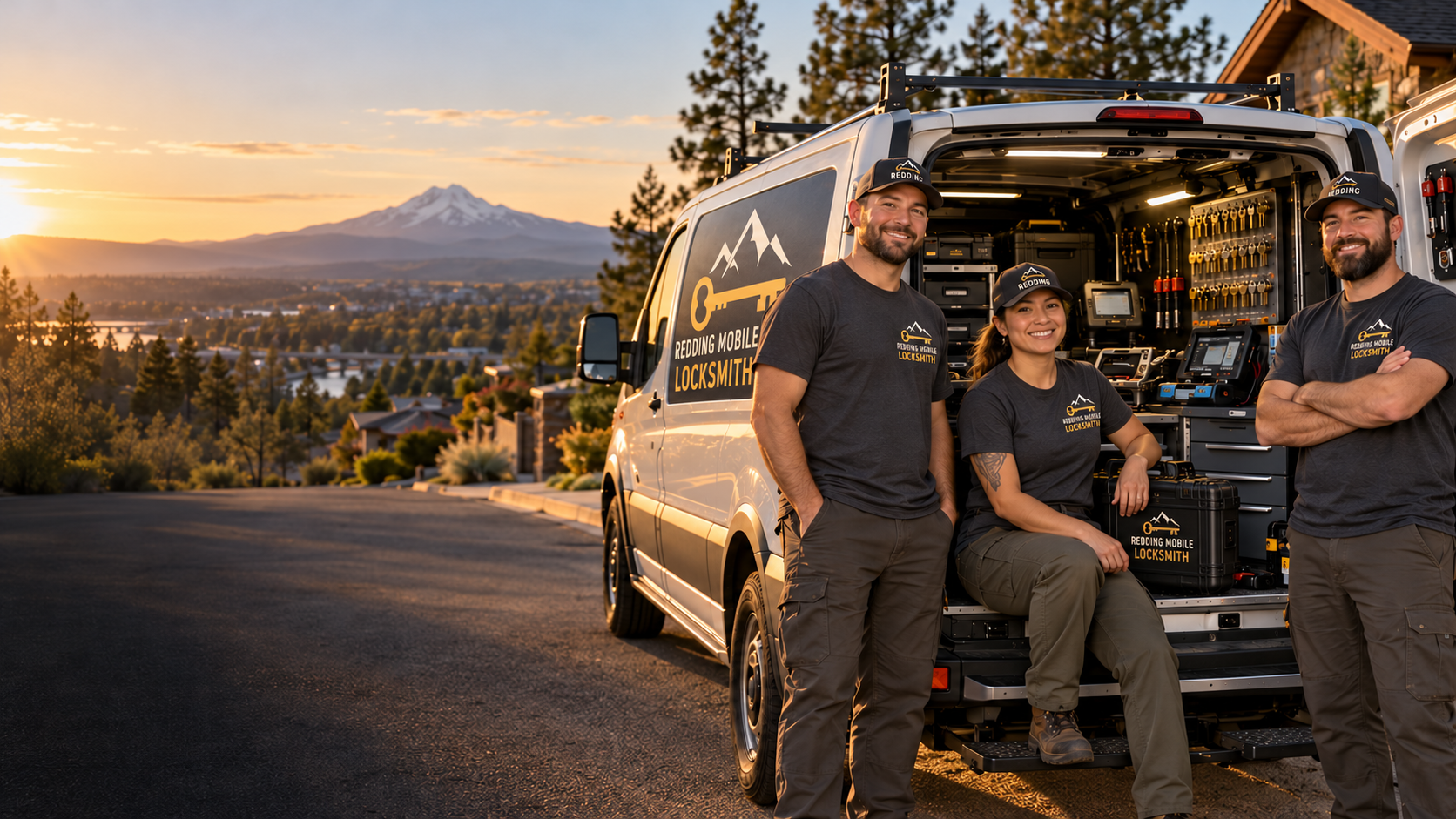
Redding Mobile Locksmith is a 24 hour mobile service, and the Alpine Dispatch crew serves Fort Jones in ZIP 96032 as part of a service area that reaches across Shasta and Siskiyou counties. Our team wears uniforms and drives a branded service van loaded with professional tools, key cutting and programming equipment and common hardware, so we come to you and do the work where the lock is.
The sections below take the situations people here bring to us one at a time. Each links to a deeper page, so you can follow the thread that matches your own property. Nothing here is meant to be a sales pitch. It is a description of how a mobile crew thinks about the doors, gates and vehicles of a working valley.
Ranch and farm properties
The defining feature of Scott Valley is working land. A ranch or farm may have a main house, a second residence, a shop, several barns, equipment sheds, a hay storage building, fuel tanks and a gated entrance. Each has a lock or should have one, and each tends to have its own key.
That is a recipe for a heavy key ring. It is also an invitation for confusion, because over the years locks are replaced one at a time with whatever was on hand. A single visit to sort the whole property onto a plan, such as a few matching key sets for different areas, is often the most useful thing a locksmith can do.
Our notes on barn, shop and outbuilding locks and gates and padlocks on rural property outline the choices, and gate and fence latch security covers the latches that hold gates shut.
Seasonal help is part of valley life. Haying crews, irrigation workers and hired hands come and go, and each may need access to a gate, a shop or a feed room for a few weeks. The tidy way to handle that is a dedicated key for seasonal access, which you can collect at the end of the season, and a main set that never leaves your hands.
If a key from an earlier season never came back, rekeying that lock restores control. It is a small job compared with worrying about who might still hold a copy.
Fuel tanks and chemical storage deserve extra thought. These are items you want locked, and the lock should be one that is hard to cut and easy for authorized people to open with gloves on. Heavy shielded padlocks and good hasps are worth the attention.
- Group outbuildings by who needs access and key each group alike.
- Choose weather resistant padlocks for gates and exposed doors.
- Mount hasps with through bolts instead of short screws.
- Keep a written record of which key opens which lock.
Cold winters and the lock that will not turn
Scott Valley winters can be sharp. Frost forms early, nights run cold, and a lock cylinder with a trace of moisture inside will freeze. The key goes in and does not turn, or it turns halfway and stops.
The worst thing to do is force it. A key that is bent, twisted or hammered can snap off inside the cylinder, and then you have two problems. The better move is to warm the lock gently, which might mean waiting, then use a dry lubricant sold for locks.
Our guides on a deadbolt that sticks only in the cold and winter lockouts and frozen locks explain the physics and the fixes. If a lock repeats the problem, the cylinder may be worn, and lock repair in Fort Jones will tell you whether it can be saved.
Door seals and weatherstripping affect locks in the cold. A door that lets in a draft also lets in moisture, which finds its way into the latch and cylinder. Fixing the seal sometimes helps a lock more than any lubricant. Our piece on locks and door seals in mountain homes explains the relationship.
Older homes in town
The older houses in Fort Jones often carry their original charm and some of their original hardware. Doors that have been painted many times, locks that have been replaced piecemeal, and windows with latches that no longer close all the way are common.
None of this is a crisis, but it is worth a look. A thorough walk around the house turns up the weak spots: a back door with a flimsy latch, a window that opens with a nudge, or a garage entry with no deadbolt at all.
We can rekey the locks you want to keep, replace the ones that have given out, and talk through windows and other entries. A home security walkthrough: lock edition shows what to check, and window locks for older homes deals with the latches that are easy to forget.
A plain observation about old houses is that they were built for a different age. Many were designed with a single lock in mind and a trust that the neighborhood watched over them. Modern needs are different, and adding a sturdy deadbolt with a properly anchored strike plate is often the single most useful improvement.
Locked out of the house
The door swings shut, the keys are on the table, and you are standing on the step. In a small town you may know everyone, but nobody has a key to your house, and calling the neighbor does not open the door.
We drive to the address, confirm that you live there, and look at the lock. Our goal is to open it without harm, so you keep your hardware and your door frame. If the lock turns out to be worn or damaged, we talk through repair or replacement while we are there.
The details are on house lockout in Fort Jones, and the general house lockout service page explains the steps. For the future, storing spare keys safely shows how to plan ahead.
Plan for the second time. Once you have been locked out, set up a safety net: a spare held by someone nearby, a lockbox with a code, or a keypad on one entrance. Any of these turns a stressful event into a short walk. We are glad to talk through which one suits your house.
Trucks, trailers and equipment keys
Valley work runs on vehicles. A rancher may have a truck, a flatbed, a stock trailer and a side by side, each with its own key and some with more than one lock. When a key goes missing in the middle of a busy week, the whole schedule suffers.
Keys for modern trucks often carry a chip, and the engine will not run without it. Our van carries key cutting and programming equipment for that kind of key, which means we can usually make and program a new one where the truck sits, without a tow.
Our pages on car lockout in Fort Jones and car key replacement in Fort Jones describe the service. For equipment, see trailers and hitch locks. If a child or pet is locked in a vehicle, call emergency services first.
Work trucks live hard lives. Keys are carried in pockets with tools, wet from rain and covered in grease. A worn key and a tired lock cylinder wear each other down. If your truck key has begun to stick in the ignition or the door, treat it as an early warning and have a spare made while the original still works.
For trailers, remember the coupler and the hitch pin. A trailer coupler lock keeps someone from hooking up and driving away with it, and the lock itself needs the same care as any other. Salt, mud and winter slush wear them down, so a rinse and a dry lubricant at season change is worthwhile.
Small businesses on the main road
The business community in Fort Jones is small and local. Shops, offices, service operations and places that welcome travelers each have a few doors and a ring of keys. The owner often does everything from sweeping the floor to counting the till.
That makes simple systems valuable. A door that closes by itself, a key that is easy to identify, and a short closing routine keep the day from ending with a struggle. When staff change, rekeying the locks restores clarity.
The commercial locksmith in Fort Jones page explains how we work with a small business, and office suites and keys when staff change and restaurant back door hardware offer practical background.
There is one more habit worth encouraging in a small business: a shared closing checklist. List the doors to lock, the lights to turn off and the keys to return to a hook or a drawer. When everyone uses the same list, nothing depends on one person's memory.
Rekeying when keys have gone astray
Rekeying is the quiet fix that solves a lot of problems at once. It changes the internal pins of a lock, so old keys stop working and new keys take over. The lock stays where it is. For a ranch house that has changed hands, a rental that has turned over, or a key ring that went missing in a field, it is usually the right answer.
The work is straightforward. We remove the cylinder, replace the pin stack to match a new key, reassemble and test. A property with several locks can be set to a single key or to a small set of keys, depending on how you want it organized.
Learn more at rekeying in Fort Jones and the rekeying service page. If you are weighing rekeying against a new lock, rekeying or replacing: a decision walk through helps you think it through.
Rekeying is also a courtesy to yourself. Once the keys are reset, you can stop wondering who might have a copy. That peace of mind is a real part of what you are paying for, and it lasts as long as the new keys are handled with care.
It is worth a word about timing and planning. If a property is about to change hands, rekeying should be scheduled with the move, so the new keys are ready on the first day. If a tenant is leaving, rekey after the keys come back, not before. Small decisions about sequence prevent awkward gaps in control.
Dust, heat and the dry summer
Summers in the valley are hot and dry. Dust blows across the land and settles in latches and keyways. A lock that sees both dust and the overnight temperature drop ends up with a gritty feel.
Maintenance is not complicated. Clean the keyway with compressed air or a soft brush, add a dry lubricant, and check that screws and strike plates are tight. Avoid heavy oil, which holds dust like glue.
The note on why locks stick in hot summer weather covers the heat side of the story, and lock lubricants: what helps and what hurts explains what to use.
A few other signs of a lock in trouble are worth watching for: a key that needs a wiggle to turn, a deadbolt that lands only when you lift the door, a latch that rattles, or a handle that droops. Each one is a small voice asking for attention, and attention costs little before failure.
How to ask for help
Our phone line is coming soon. For now, every request begins with the form on the contact page. Include your address or directions, any gate details, the type of lock or vehicle and what happened.
On large properties, access details matter. A locked gate, a long lane, a dog and a turnoff with no sign can all slow a visit. If you tell us about them ahead of time, we can plan around them.
Use the service request form, or read the 24 hour emergency locksmith page for how urgent calls are handled.
If you are not at the property when we arrive, tell us who will meet us. A trusted person with proof that they may authorize the work can let us begin. For a lockout, we still need confirmation that you live there, so plan to be present or to provide it in a way we can accept.
Tell us too if there is a deadline, such as livestock to feed, a delivery coming or a child to collect. Knowing what matters most helps us prepare.
Nearby communities
Fort Jones is not far from other places we serve. Yreka is the county seat. Montague sits in the Shasta Valley with older homes. Granada lies in open ranch country with outbuildings and gates.
Each place has its own feel, and we bring that to each job. The same crew standards follow us everywhere: arrive prepared, explain plainly and leave the lock working.
If you are not sure where to begin, choose the page for your town and your need, or look at the full list of services.
Across all of these places the standard is the same. We explain before we act, we protect the door and we test the lock when we finish, so you do not find out about a problem after we have gone.
Common questions
Do you drive out to ranches near Fort Jones?
Yes. We serve Fort Jones, ZIP 96032, including ranch and farm properties in the valley. Include directions, gate details and anything about access in the request form, so the crew can plan the visit and arrive with the right tools.
My key will not turn on a freezing morning. What should I do?
Stop and do not force it. Frost or moisture inside the lock is often the cause, and a forced key can snap. Let the lock warm, and avoid hot water or heavy oil. If it keeps happening, tell us and we will look at repair or replacement.
Can you key all my farm padlocks the same?
Yes. Padlocks can be keyed alike so one key opens many buildings, or grouped into a few sets for different areas. Tell us how many locks you have and who needs access to which, and we will suggest a plan that fits your property.
Can you make a key for a truck that has a chip?
In many cases, yes. Our van carries key cutting and programming equipment, so we can cut the key and program the chip to the vehicle on site. You will need proof of ownership, and the make, model and year help us prepare.
What do you need to see before opening my house?
We need to be sure you live there. Identification that shows your name and the address is the usual proof. If you cannot provide it, tell us and we will explain what alternatives might work before we begin any work on the door.
How do I reach you if there is no phone number yet?
Our phone line is coming soon. Until then, use the request form on the contact page. Tell us where you are, what lock or vehicle is involved and what happened. We read each request carefully and prepare for the visit.