
Home / Field notes / A child or pet locked in a vehicle, call emergency services first
Field notes: emergency
A child or pet locked in a vehicle: call emergency services first
If a child, baby or animal is inside a locked vehicle, stop reading and call 911. A locksmith is not the first call. Emergency crews are, and everything else can wait.
Call 911 now, then read the rest
This is the one situation where we ask you to stop and act before anything else. If a child, a baby, a pet or any person who cannot get out is inside a locked vehicle, call 911 right now. Say where you are, say what you see, and follow what the dispatcher tells you. Do not wait for a locksmith, do not search for a spare key first, and do not delay the call to figure out whose fault it is.
We are a mobile locksmith team, and we take pride in getting people back into their vehicles. But our work is not rescue work. Fire, police and medical crews have the training, the authority and the equipment to deal with a person in danger. They know how to enter a vehicle safely and with care when a life is at risk, and they know what to do for the person once they are out.
If you are reading this because you are calm and somebody else is in trouble, share the message. Tell the person next to you to call 911. Tell the parent who is frozen at the window that help is on the way. Then stay with the vehicle, keep the occupant in view, and talk to them if they are conscious.
Why we say emergency services come first
A closed vehicle can become dangerous in a short time. Sunlight through the glass heats the interior, and the air has nowhere to go. Temperatures inside can climb far above the temperature outside, even on a mild day, and cold can be just as harmful in the mountain towns. A child or an animal has a much harder time handling those swings than an adult does.
Because of that, time matters, and a locksmith has to travel to you. Even a very good crew needs to drive to the spot, find the vehicle and prepare. Emergency services are usually already close, they can be sent at once, and the dispatcher can guide you while they travel. That difference can matter a great deal.
The right order is simple. First, call 911. Second, keep watching and stay with the vehicle. Third, follow the dispatcher's instructions. A locksmith can come later if the vehicle still needs to be opened or the keys retrieved, but the person or animal inside must come first. We would rather you call emergency services and not need us than call us and wait.
What to tell the dispatcher
Speak clearly and give the key facts first. Where are you: a town, a street or highway, a trailhead, a parking area, or any landmark that helps. Describe the vehicle: color, type, and where it sits. Say who is inside: a baby, a small child, an older child, a dog, or another animal. Say whether they are awake, moving, crying or still.
Tell the dispatcher what you can see, not what you fear. If the windows are closed, say so. If the vehicle is in sun or shade, say so. If the engine is running or not, say so. If you have already tried the doors, say that too. Keep your phone on speaker so you can use both hands, and stay on the line unless told otherwise.
Follow the instructions you are given. The dispatcher may ask you to stay near the vehicle, to keep the occupant talking, to look for help, or to take other steps. Do not argue or guess. They are trained to guide callers through this, and their directions are based on the situation they hear. Our role here is only to ask you to make the call.
- Say exactly where you are and how to reach the vehicle.
- Say who is inside and whether they are responding.
- Say whether the windows are closed and whether the engine is on.
- Stay on the line and follow the dispatcher's directions.
What you can safely do while you wait
Stay close to the vehicle and keep the occupant in view. Talk to them calmly if they are awake, so they know someone is there. Check all doors, including the rear doors and trunk, in case one is unlocked. If a family member or friend has a spare key, ask them to start bringing it, but do not let that distract you from the call.
Ask nearby people for help, and keep them calm. Send someone to meet the emergency crew at the road or the entrance of the lot and guide them to the right spot. If you are at a trailhead, a campground or a store, let staff know. Others may carry tools or have seen the vehicle arrive and can give useful details.
Make your own safety part of the picture. Stay out of traffic, watch for hot surfaces and keep other children or animals away. Do not put yourself in danger. This page is not medical advice, and we cannot tell you how to treat anyone. Emergency services will guide you on that, and the dispatcher can talk you through the steps while crews are on the way.
Why we do not describe how to open a vehicle
You may be reading this in the hope of finding out how to get a door open yourself. We will not describe that, and the reason is not caution for its own sake. Instructions that help someone open a locked vehicle would also help someone who should not be opening it. It is not the kind of information that should be a public how to.
There is a second reason. Tricks that seem simple often fail on modern vehicles. Doors contain airbags, wiring and delicate parts, and forced entry can cause damage, injuries, or delays that make the situation worse. In an emergency, the people with the right training and tools are a better choice than a stranger with a video in mind.
If emergency crews decide that entry is needed, they will take responsibility for it. If the situation is not an emergency, for example an empty vehicle with keys inside, that is a different matter, and our car lockout page explains how a professional locksmith handles it. The key point is to separate the two situations clearly, and to make the emergency call first when someone is inside.
After the emergency is over
Once the occupant is safe and in the care of the crew, the vehicle may still be locked, the keys may still be inside, or a window may have been broken to reach them. At that point you have a vehicle problem, not an emergency, and that is when a locksmith helps. If the vehicle was opened without damage, you may only need to retrieve the keys or sort out a broken lock.
If a window was broken, the vehicle will need repair before it can be left safely. A glass shop can help with that, and we can help with any lock, key or ignition issues. If the lock or door was damaged, our automotive locksmith page lists what we handle.
Take a breath, and be kind to yourself. Many caring parents and pet owners have had a moment of distraction, and the moment is not a measure of their love. What matters now is learning from it and setting up habits that make it less likely to happen again. The next sections are about exactly that.
How this happens to careful people
It rarely happens because someone is careless. It usually happens when routine changes. A parent who normally drops the child at care is handling the drop off for the first time. A caller on the phone is distracted at the moment of stepping out. A pet that usually rides in the back has jumped into the front seat and hit the lock button. A baby falls asleep in the back seat, and the driver forgets the seat is occupied.
Smart keys add another layer. A fob in a bag on the seat can sometimes be locked in with the occupant, and the car may lock when the driver walks away. A child who is old enough to climb into a vehicle can also pull a door shut behind them at a driveway, a trailhead or a campground. Rural and recreational settings are not immune. They are often busier, with more distractions.
The point is not to scare anyone but to name the patterns. When we know how it happens, we can build habits against it. Most of those habits cost nothing, and they take only seconds.
For bystanders and neighbors
If you are the one walking past a parked vehicle and you notice a child or animal inside, you are in a stronger position than you may feel. You do not need to know the owner. You do not need to solve anything. Your job is to call 911, describe what you see, and stay nearby until help arrives. That is enough, and it matters a great deal.
Note the vehicle details while you wait: color, type, where it is parked, and how long you have been watching. If you are at a store, a trailhead, a school lot or a campground, tell the nearest staff member or host so they can help look for the owner. Ask them to make an announcement if there is a way to do so. Many owners are only steps away and will return as soon as they hear.
Be gentle when the owner appears. A person who has just realized what happened is often frightened and ashamed. The priority is the safety of the occupant, and the conversation about habits can wait. Stay calm, let the crew do its work, and offer simple help such as water for the family or space for the crew to move.
Habits that help
A simple habit used by many families is to put something you need in the back seat, such as a phone, a bag or a shoe, so that you must open the rear door every time you leave the vehicle. Another is to keep a stuffed toy in the car seat when it is empty and move it to the front when the seat is occupied, as a visible reminder.
Make it a rule to look before you lock, every time, even when you are alone. Check the back seat, the floor and the cargo area. For pets, never leave an animal in a parked vehicle, even for a short errand. Bring the animal, or leave it at home. For children, never leave them alone in a vehicle for any reason, even a minute.
Teach older children that vehicles are not play spaces. Keep keys and fobs out of their reach, and lock the vehicle when it is parked at home so children cannot climb in and become trapped. If you have a driveway or a yard, a locked vehicle is a safer vehicle. Our locks and household safety for young children guide covers home habits.
Keys, spares and being ready
Part of readiness is knowing where your spare key is and who can reach it. A spare kept at home is only useful if someone is there. A spare kept with a trusted relative or neighbor can help in many situations, though not in an emergency, where the call to 911 always comes first. Our notes on storing spare keys safely go through sensible places.
Another part is knowing your key type. If you have a smart key or a remote head key, a spare is more involved than a hardware counter copy, so plan ahead. Our car key types in plain words guide helps you tell what you have, and a spare key now versus later sets out the case for acting early.
A final piece is a plan for the day it happens anyway. Save the habit of calling 911 first. Tell everyone who drives your vehicles that this is the rule in your family. A moment of agreement now removes any hesitation later. The fastest decision is the one you have already made.
When a locksmith is the right call
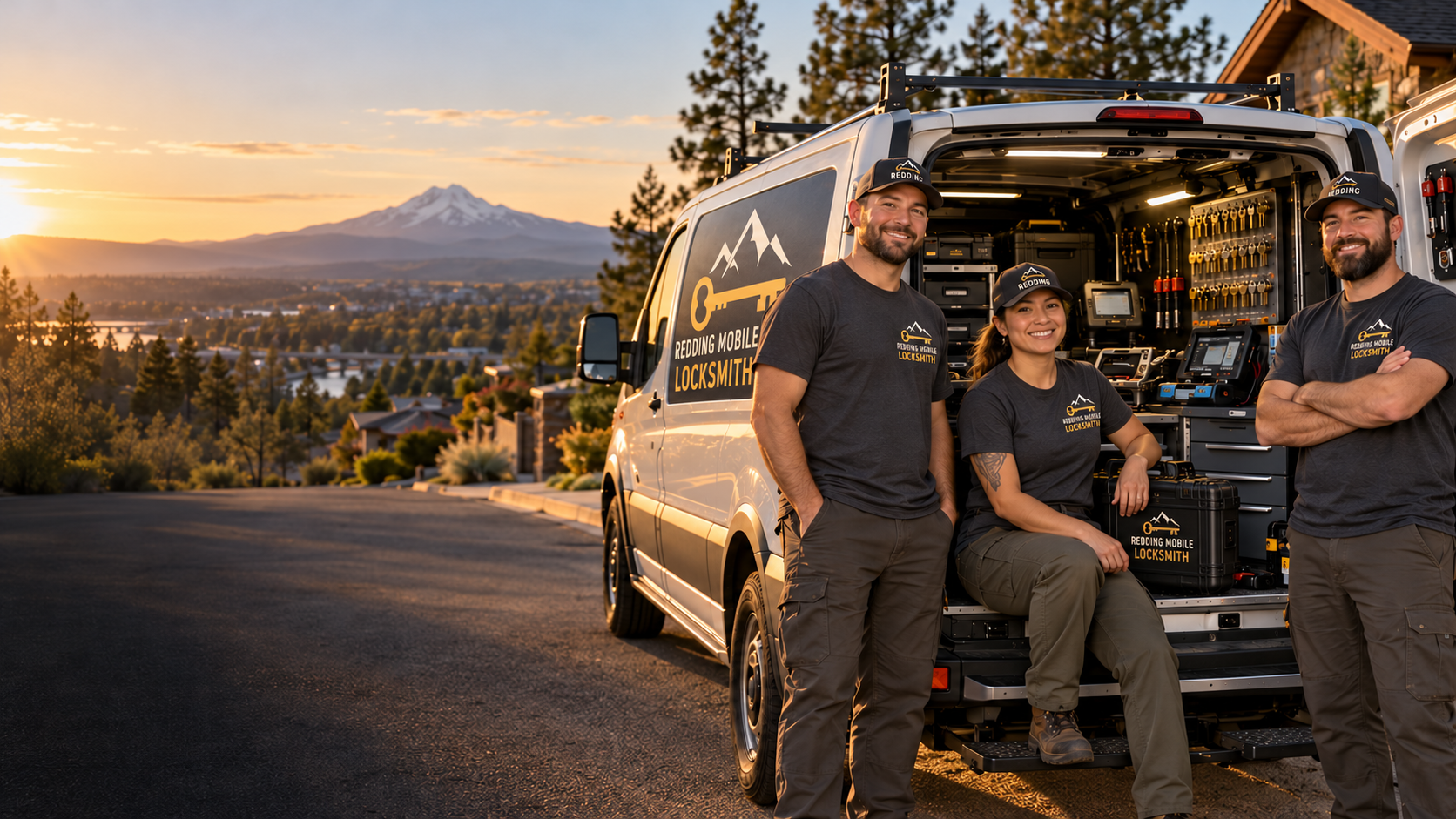
Once no one is inside, and the problem is a lost key, a lockout or a damaged lock, a locksmith is the right call. We help with car lockout, car key replacement and key programming, and our team works across Shasta County and Siskiyou County. Our crews arrive in uniforms in a branded service van with the tools and equipment needed.
We do not publish a phone line yet. Use the request form and tell us the vehicle, the place and the problem. If the situation involves anyone inside the vehicle, do not use the form. Call 911 instead. The form is for the part that comes after.
We hope you never need this page. If you do, remember the one instruction that matters: call emergency services first, stay with the vehicle, and follow the dispatcher. Everything else, including the keys, the lock and the door, can be sorted out once everyone is safe.
Common questions
Who should I call if a child is locked in a car?
Call 911 immediately. Do not call a locksmith first and do not wait for a spare key. Tell the dispatcher where you are, describe the vehicle and who is inside, and follow their instructions. Emergency crews are trained and equipped for this and can be sent right away.
What if my pet is locked in a hot or cold car?
Treat it as an emergency and call 911 or the local emergency line, and tell them an animal is inside. Stay with the vehicle, ask nearby people for help, and follow the dispatcher's guidance. A locksmith can help later with keys or locks once the animal is safe.
Can a locksmith reach me before emergency services?
Do not count on it. A locksmith must travel to you, while emergency crews are organized to respond at once and can guide you by phone. The right order is to call emergency services first. A locksmith is for the vehicle problem that remains once everyone is safe.
Should I break a window myself?
Do what the dispatcher tells you. They hear the situation in real time and can advise you, and crews may arrive soon. Acting on your own can cause injury or damage and is not something we can advise. Call first, stay on the line, and follow their direction.
What can I do to avoid this happening?
Build habits: check the back seat every time, put a needed item in the back, keep keys away from children, and never leave a child or pet alone in a vehicle. Lock the vehicle at home so children cannot climb in. Small routines remove most of the risk.
Will you help after the emergency is over?
Yes. Once the occupant is safe, we can help with the lock, key or ignition problem, whether that means a lockout, a replacement key or a repair. Use the request form on our contact page to describe the vehicle and the situation, and we will explain what the work involves.