
Home / Field notes / Wildfire season go bag: where your keys belong
Field notes, fire season
The wildfire season go bag and where your keys belong
Most go bag lists cover water, papers and medicine, then forget the small metal things that open the house, start the truck and lock the gate. This note walks through the keys that deserve a place in the bag and how to carry them.
Why keys belong in the plan before the smoke shows up
Anyone who has lived through a North State summer knows the rhythm. The valley bakes, the ridgelines go hazy, and every few weeks somebody on the road mentions a column of smoke over the hills. Most of the time it is far away. Once in a while it is not, and the people who handle it calmly are the ones who decided what to carry weeks earlier, when nothing was urgent.
Keys are an odd item on that list because they feel too ordinary to plan around. They live in a bowl by the door, a hook in the kitchen, a jacket pocket, a console in the truck. When you have a few minutes to leave, ordinary things scatter. A key ring ends up in the wrong coat, a spare is left on a nail, and the one fob that starts the second vehicle stays in a drawer.
We are a crew that spends its days opening doors and cutting keys for people across Shasta and Siskiyou counties, so we see how a missing key turns a hard day into a longer one. This note is about prevention. It covers which keys belong in a go bag, how to carry them so they survive heat and rough handling, and how to keep the whole system honest from one season to the next.
What a go bag is actually for
A go bag is a single container you can pick up without thinking. It exists so the decisions are already made when your head is full of other things. Water, copies of important papers, chargers, medicine, a change of clothes and a few days of essentials are the usual contents, and good local agencies publish thorough lists you should follow for those items.
What those lists rarely spell out is access. You are not only leaving a place, you are expecting to come back to it, and you may be living out of a vehicle in the meantime. Access means the key to the vehicle you are driving, the key to the place you might stay, and the key to the house you are leaving behind, which you will want to lock properly even if the road is crowded and the hour is tense.
Think of the key section of the bag as a small kit with three jobs: get you moving, let you get back in, and let someone you trust act on your behalf if you cannot. Everything we suggest below comes back to those three jobs. If a key does not serve one of them, it can stay home.
The key inventory: what earns a spot
Sit at the kitchen table with every key your household uses and sort them into piles. You will probably find more than you expected, because keys accumulate. A pile for vehicles, a pile for the home, a pile for outbuildings and gates, a pile for work, and a pile of mystery keys nobody can name. The mystery pile is worth an honest look, since an unlabeled key that opens nothing is just weight.
Not every key needs to travel. The test is simple. If you would be stuck or stranded without it, it goes in the bag. If it only matters when you are standing at home, it can be stored somewhere safe instead. A key to a back shed matters less than the key to the vehicle that will carry you out.
Here is the short list most households end up with once they sort honestly.
- A spare key or fob for every vehicle you might drive out, kept apart from the one on your daily ring.
- A front door key for the house you are leaving, so you can lock it and a trusted person can enter later.
- Keys to a safe, lockbox or file cabinet that holds papers you cannot replace.
- Keys for a rural gate, so a person who needs access can find you or reach the property.
- Keys to a second home, cabin or relative's house where you may end up staying.
Vehicle keys and fobs get special care
Modern vehicle keys are small computers. A transponder key carries a chip that the ignition reads, and a smart key or fob talks to the car by radio so a push button can start it. If you have ever priced a replacement, you know these are not casual items. If you are curious how the pieces fit together, our guide to transponder keys explained covers the chip and the lock, and the note on smart keys and push button start covers the radio side.
Two habits matter most for the bag. First, put a spare in it that you have actually tested. A spare that was cut but never programmed will turn the door lock and do nothing in the ignition. If you are not sure yours works, find out before fire season, not during it. Our key programming work exists for exactly this kind of check.
Second, give fobs fresh batteries at the start of the season. A weak battery can leave a smart key unable to start a car, and heat does not help. Our short note on key fob battery basics explains the warning signs. If you realize you only own one working key, the sensible move is to get a second one made through car key replacement while the road is clear.
How to carry them: pouch, ring and heat
Loose keys at the bottom of a duffel are how keys get lost. Use a small zip pouch with a hard sided case or a tin inside it if you can, and clip the pouch to an interior loop of the bag so it cannot migrate. A small pouch also keeps sharp bitting from poking through fabric, and it keeps a fob from being crushed under a laptop.
Heat is a real consideration in this country. A bag left in a parked vehicle on a summer afternoon gets hot enough to warp plastic and shorten a battery. If your go bag lives in a car trunk, plan for that. A shaded closet inside the house is a better home for it, and a tin or hard case adds a small amount of insulation if you need to stage the bag in the vehicle overnight.
Keep keys sorted on their own rings by purpose, not on one giant bunch. A ring for the vehicle, a ring for the house, a ring for the property. If you are ever in a hurry or handing the bag to someone else, this separation means nobody has to guess. Do not write your address on any tag. A plain colored tag, or a short code only you understand, does the job without telling a stranger where the keys fit.
The spare key trap
There is a common pattern in households that think they are prepared. The spare vehicle key is in a drawer at home, the spare house key is under a flowerpot or in a lockbox by the door, and the family assumes that is the plan. The problem is that if you must leave, those spares stay behind and are no use to you on the road.
The reverse trap is just as real. Some families put every spare in the go bag, which is fine for you but leaves nothing at home if the bag gets wet, lost or stolen. A better pattern is to split. The bag holds a working vehicle spare and a house key. A second spare lives with someone you trust who lives outside your immediate area, ideally in a different part of the county or beyond.
A key hidden outside the house deserves a second look at any time of year, since the hiding places people choose are the ones thieves check first. Our note on hiding a key outside and better options lays out safer habits, and storing spare keys safely goes into how to keep a spare without advertising it.
Rural properties: gates, outbuildings and shared keys
Out on acreage, the key ring is longer. There is a gate lock or a chain, a barn or shop door, a tractor key, an equipment shed, a mailbox, and maybe a padlock on a propane cage. In a fire emergency, responders may need to get through a gate, and neighbors may need to move livestock or equipment. A gate that nobody can open is a problem on a very bad day.
Talk with your household and with trusted neighbors about who holds a gate key and where it is. A simple written log, even a note in the go bag listing who has which key, saves confusion later. Our guides on farm gate keys and who should hold them and gated driveways, chains and gate lock choices take that conversation further.
If you hold keys for a property with several buildings, consider whether one key plan could replace a jangling ring. A single keyed alike set, or a system that sorts access by building, makes a bag lighter and an emergency calmer. Our note on properties with several buildings and one key plan explains what that looks like in practice.
Keeping the bag honest through the season
A go bag is only as good as its last check. Pick two dates that are easy to remember, such as the first warm weekend of spring and the day you change your clocks in the fall, and walk through the bag on both. Check that every key is still in the pouch, that each fob has a charged battery, and that the spare still starts the vehicle.
Any time you change a lock, the bag needs an update. If you have a locksmith rekey the front door after a move, the old key in your bag now opens nothing. The same is true after a lock replacement through lock installation. It sounds obvious, yet it is the most common way a go bag quietly goes stale.
If you share a home with others, assign the job. One person owns the bag check, and everyone else knows where the bag lives. If a teenager drives, make sure they know which key is theirs and where the vehicle spare sits. Our note on teaching teens to look after keys is a gentle way into that conversation.
Households with different needs
Not every home has the same shape. A household with an older relative may need a caregiver to enter the house, so a labeled key for that person belongs in the plan. Our guide to a caregiver key plan for a relative at home covers the details, and easier locks for aging parents describes hardware that makes leaving and returning less stressful.
Renters have a different set of questions. You may not be allowed to change a lock, and the landlord may hold the only spare. It is worth asking, in a calm moment, who has copies and what the process is if you need access after being away from home. Our list of landlord and tenant lock questions to ask gives you a place to start. Rules vary from one rental to the next, so ask rather than assume.
People with a keypad lock or smart lock should still pack a mechanical backup. Batteries die, apps lose signal, and power can be out for days in a fire event. A physical key in the go bag turns a smart lock back into something you can open and close with no network at all.
If you have been separated from your keys
Even with a careful plan, some people end up away from home without keys, or return to a vehicle with the fob left behind. If that happens, stay calm and do not force anything. Forcing a door or an ignition can damage the vehicle and complicate the repair. A mobile locksmith can come to the place you are, which matters when you are not near home.
For vehicle keys, gather what you can before you call: the vehicle make and model, the year if you know it, and proof that the vehicle is yours. Our guide on lost every key and what to gather lists the details. If the doors are locked with the keys inside, car lockout service opens it without harm when it is done properly, and house lockout service does the same for a door.
If a child or pet is inside a locked vehicle, call emergency services first. That is not something to solve with a locksmith as the first call. Everything else can wait for us, and we will get to you as soon as we can once you reach out through the request form.
Where we fit in
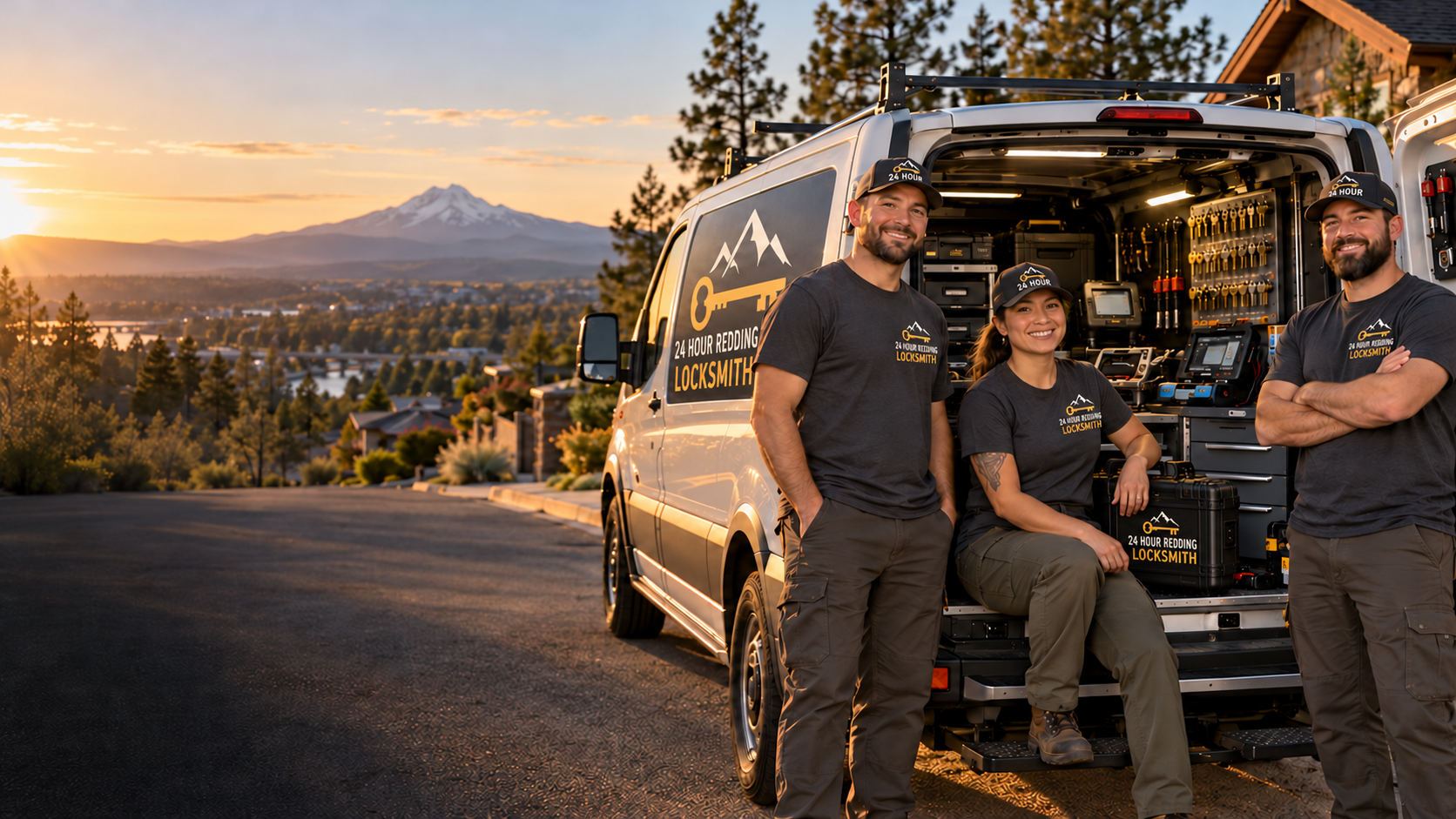
We are a 24 hour mobile team in uniforms with a branded service van, and we cover the communities of Shasta and Siskiyou counties from Redding to Yreka. The work behind this note is simple. We cut keys, program fobs, rekey doors, repair locks and open what is shut, and we carry the tools for all of it. You can read more about who we are on the about page.
If you are building your go bag this season, the useful next step is to pick one task and finish it. Test the spare vehicle key. Make a second copy of the front door key. Replace the fob battery. Each of those is small, and each one removes a way the day could go sideways.
Local pages for your town, such as Redding, Mount Shasta and Anderson, list the work we do near you. If you want a key made or a spare programmed before the season peaks, send us a note on the request form and we will talk it through with you.
Common questions
Which keys should always go in a wildfire go bag?
A working spare for any vehicle you might drive, a key for the house you are leaving, and keys for safes or lockboxes that hold papers you cannot replace. Add gate keys if you live on rural property. Leave everything else at home in a safe place.
Should I keep my only spare vehicle key in the go bag?
It is better to keep one working spare in the bag and a second with a trusted person elsewhere. That way a lost or damaged bag does not leave you with no spare. Test the spare in the ignition before the season so you know it works.
How should I protect a key fob from heat?
Store the bag in a shaded spot inside the house instead of a parked car, and put the fob in a hard sided case or tin. Replace the battery at the start of the season, since heat and age both shorten battery life.
Is it safe to label keys with my address?
No. A tag that names your address tells a stranger exactly where the key fits. Use a colored tag or a short code only your household understands, and keep a private list of what each tag means somewhere safe.
What if I have a keypad or smart lock?
Keep a mechanical key for it in the go bag. Batteries, power and network signal can all fail during an emergency, and a physical key lets you lock and unlock the door without any of them. Check that the key still turns the cylinder.
Can a mobile locksmith help if I am away from home when I need a key?
Yes. We come to your location across Shasta and Siskiyou counties, and we can cut or program vehicle keys and open locked vehicles on site. If a child or pet is locked inside a vehicle, call emergency services first.