
Home / Cottonwood / Car Key Replacement in Cottonwood
Cottonwood car keys
Car key replacement in Cottonwood, from simple cut keys to smart fobs
A lost or broken car key is more than a piece of metal to replace. We bring cutting and programming equipment to your vehicle in Cottonwood, and this page explains the key types and how each one is replaced.
A cabin owner back after weeks away
Imagine a seasonal cabin owner who has spent weeks away and drives back toward the hills. At a stop near Cottonwood, she reaches into her bag for the car key and finds only the cabin key and a gate remote. The car key is somewhere else entirely: in a coat at the cabin, in a rental she returned, or in a drawer at home. The car sits in a parking space, locked, with no way to start it.
That is a loss of the whole key, not a lockout, and it is a different problem. Opening the door will not make the engine run. A key for a modern car does two jobs, mechanical and electronic, and a replacement has to do both.
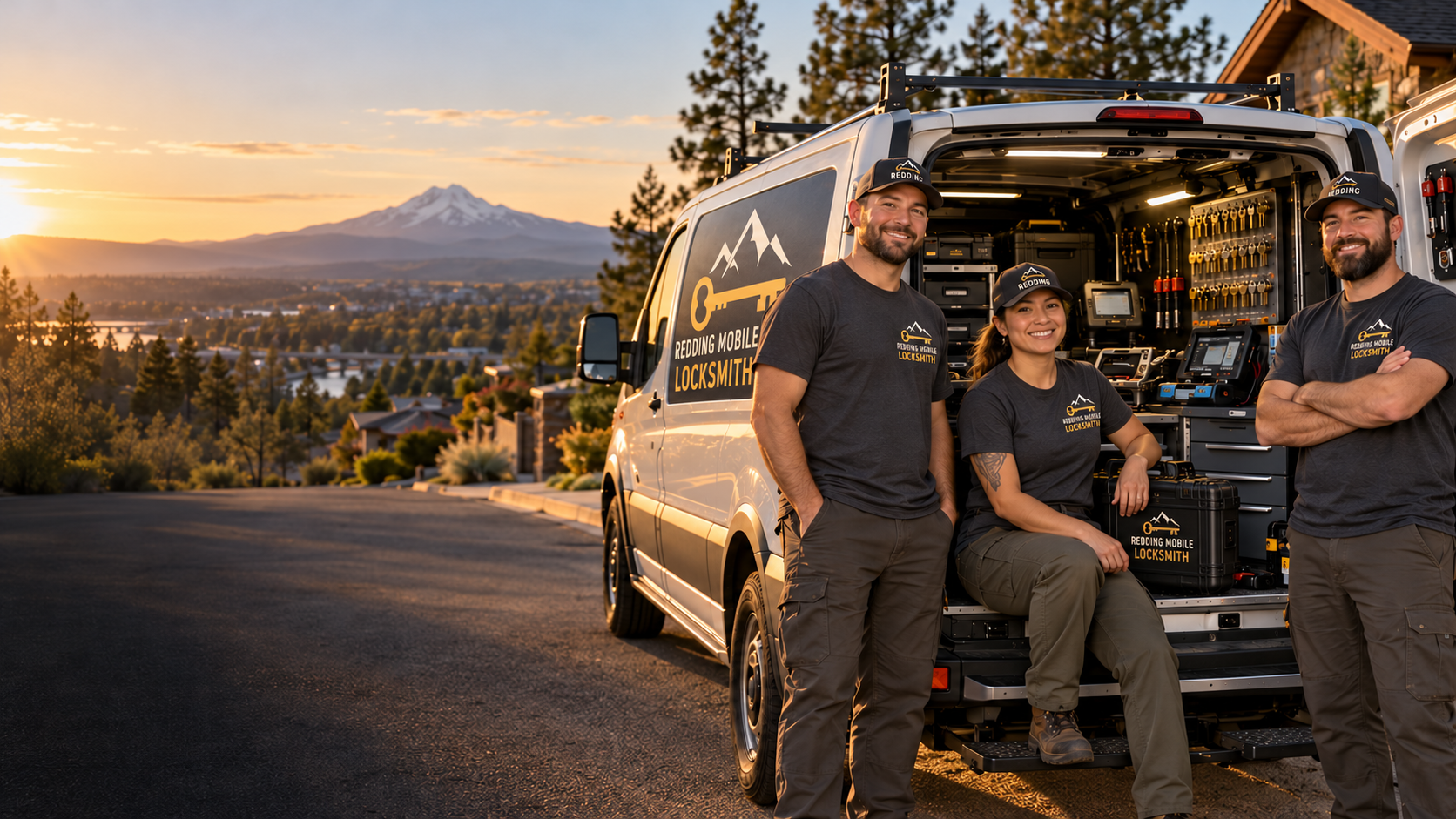
If that scene feels familiar, the request form is the way to begin. Tell us where the vehicle is, what kind of key it used and what you still have. Our branded service van carries cutting and programming equipment, so many replacements can happen right at the car.
There is also a practical lesson in the scene. The cabin owner has one set of keys for the cabin, one for the gate and one for the car, and they live on different rings in different places. Putting them in one spot sounds convenient and creates a single point of loss. Giving each its own home, plus a spare held by someone trusted, is a better answer, and it costs nothing to set up.
The four broad kinds of car key
Car keys come in a ladder of complexity. At the bottom are plain metal keys, cut by pattern and nothing else. Next come transponder keys, which look similar but have a small chip in the head. Then there are remote head keys, which combine a key blade with lock and unlock buttons. At the top are smart keys, also called proximity fobs, which start a vehicle with a push button and may never touch a lock at all.
Which one you have depends mostly on the age and trim of the vehicle. A key from an older truck or work vehicle may be plain metal. A family car from the last couple of decades probably has a chip. A newer one may have a smart fob.
Our guide to car key types in plain words gives a good tour of the differences with simple descriptions, and it helps you tell your own key apart before you call.
Cost and effort follow the same ladder, though we do not quote prices here. A plain key is the simplest job. A transponder key adds programming. A remote head key adds pairing. A smart key adds the most steps. Knowing where your key sits on the ladder helps you set expectations before you call, and helps us give you a useful answer without a long back and forth.
If you are not sure which type you have, look at the head of the key. A thick plastic head often hides a chip. Buttons on the key mean a remote. No visible key blade at all usually means a smart fob. A photo of the key, front and back, is a useful thing to attach to your request, and it spares us a round of questions.
- A plain metal key with no chip and no buttons.
- A transponder key, with a chip hidden in the plastic head.
- A remote head key, which adds lock and unlock buttons.
- A smart key or proximity fob used with push button start.
Plain keys: the simplest replacement
A plain automotive key is cut to match the vehicle's lock. If you have the old key, a copy can be cut from it. If you lost every key, a locksmith can cut a new one using the vehicle information and the lock itself. The process is mechanical and does not involve any electronics.
These keys are getting rare, but they are still found on older vehicles, on some trailers and utility vehicles, and in some secondary locks such as a glove box or a trunk. They use very little material, but they still must be cut accurately. A blade that is slightly off can feel gritty or refuse to turn.
On rural properties in Cottonwood, older work vehicles and farm trucks sometimes use plain keys. If yours is one of them, replacement is usually straightforward, and we test the key in the door and the ignition before we leave.
Even a plain key can be tricky when the lock is worn. A lock that has been used for many years may only work with the original key, because the pins have settled to its wear pattern. A fresh copy cut to factory dimensions may feel stiff at first. Testing in the lock, trimming slightly if needed and cleaning the keyway usually solves it, and we do this as part of the visit.
Transponder keys and the chip inside
A transponder key contains a tiny chip that holds a code. When you put the key in the ignition, the car sends a signal, the chip answers, and the vehicle decides whether to allow the engine to start. If the code is wrong, the engine may crank briefly or not at all. This is an anti theft feature, and it is why a copy cut at a hardware counter may open the door and still fail to start the car.
Replacing a transponder key therefore takes two steps. First the blade is cut, then the chip is programmed so the car accepts it. The programming uses special equipment connected to the vehicle, which we carry in the van.
If you want to understand the mechanism better, our guide on transponder keys explained walks through it in order. If programming is the part that puzzles you, our key programming page covers it directly.
Because the code lives in the chip, some vehicles allow a new key to be added with the help of an existing one, while others require a connection to the vehicle's computer and a security process. The details depend on the car, and we explain which applies before any work starts. We do not guess, and we do not start cutting before we know the path.
A related point is the immobilizer. When the car does not recognize a key, it may disable the fuel or the starter on purpose. People sometimes mistake that for a dead battery or a failed starter and spend time on the wrong repair. If the engine turns over and then dies, or if a small key shaped light blinks on the dashboard, the chip may be the cause.
Remote head keys and fobs
A remote head key combines the blade, the chip and the buttons in one body. Replacing it means cutting the blade, programming the chip and pairing the remote buttons with the vehicle. Each part must be done correctly or something will not work.
Sometimes only the remote side has failed. The key still starts the car but the buttons do nothing. A battery change might fix it, and a simple test can tell you. Our guide to key fob battery basics shows you how to check before you spend on anything else.
If the buttons are worn, the case is cracked or the remote has been through the wash, a new one may be better than a repair. We tell you which route fits the damage and, importantly, what you will be able to do with the result.
It is worth asking what you actually want from the key. Some owners want every button restored, including remote start, trunk release and panic. Others want a plain working key and do not care about the buttons. A key that starts the car and opens the door is a smaller job than a full remote, and you can choose what fits your needs.
Smart keys and push button start
Smart keys are the most complex. The fob talks to the car by radio, and the car senses when the fob is inside or near. With push button start, you may never insert a key at all. Many smart fobs hide a small mechanical key inside the case, so you can still open the door if the battery dies.
Replacing a smart key is mostly electronic. The new fob must be introduced to the vehicle's computer, and the old fob may need to be removed from its memory for security. This is delicate work, and it requires the right equipment and care.
Our guide on smart keys and push button start explains how these systems work. If you have lost your only smart fob, tell us right away, because the process for a lost last key differs from adding a spare.
A smart fob should be treated with the same care as a wallet. Do not leave it in the vehicle, and do not store it near a window or on a hook by the door where it could be picked up. Keep the mechanical emergency key, often hidden in the fob, somewhere you can find it. When the battery dies at the wrong moment, that tiny key is the way back in.
What we need from you
To make the right key, we need to know what you drive. We ask for the year, make, model and, where it matters, the trim or engine. We also need proof that the vehicle is yours, because making a key to a car is a serious step. Registration and identification are the usual items.
If you still have a working key, bring it. A working key makes the job easier, because we can copy from it and add it to the system instead of creating a new set from nothing. If you have none, we can still help, but we gather different information.
Our page on lost every key, what to gather lists what to prepare. Take a moment to find the vehicle identification number, usually visible through the windshield, and have your registration handy.
If you cannot find the vehicle identification number, check the registration, the insurance card or the sticker inside the driver door frame. Take a photo of it on your phone so you do not have to find it again. A clear photo of the dashboard and any markings on the old key also helps us confirm what system the car uses before we arrive.
If the car is locked as well
Sometimes the key is lost and the car is also locked. In that case, the first step is getting into the vehicle, and the second is making the key. We can do both in the same visit. Our car lockout page for Cottonwood describes the opening step.
If the car is in a place where it cannot stay, such as a parking lot or a trailhead, tell us. We can discuss what to do about the vehicle. Do not try to force the door, since broken glass and bent frames cost far more than a lockout.
If you are traveling, plan for the possibility that a replacement takes a while. Programming, cutting and testing are careful tasks. We do not hurry them, and we do not promise times that traffic and other jobs could change.
Think about where your other keys are. If the house key is on the same ring as the lost car key, you may have a bigger problem than the car. Our crew can help with the house too, and our page on house lockouts in Cottonwood explains how. Mentioning both in the request form saves time.
A spare now is easier than a replacement later
When one key is left, the situation is far easier than when none is left. Copying a working key and adding a spare to a vehicle is a smaller task than creating a first key from scratch. Many owners wait until the last key is lost, which is the hardest moment to act.
A cabin or second home makes this more important. If you leave a vehicle for weeks, keep a spare with someone you trust, or store a spare at home. Do not leave it in the vehicle, and do not hide it outside. Our guide on a spare key now versus later goes into this.
If you also own a cabin, our notes on a lock strategy for cabins and second homes tie the car and the building together, so one plan covers both.
Programming a spare while you still have a key is often much simpler than programming the first key after all are lost. With one key available, the vehicle can be told to learn another in a short process. With none, the security system has to be worked around in a more careful and lengthy way. That is why we encourage a spare as soon as you can.
Cottonwood, Anderson and the road between
Cottonwood sits near Interstate 5, south of Anderson, so many drivers pass through on long trips. A key problem at a rest stop or a gas station is common, and we serve people like that as well as residents of the town.
Our crew covers Anderson and many other communities in Shasta and Siskiyou counties as a 24 hour mobile locksmith. We do not publish response times, but we tell you what to expect once we know where you are.
For a broader view of vehicle work, see our automotive locksmith page and our car key replacement service page. Everything specific to this town is collected on our Cottonwood area page.
Travelers sometimes ask whether they should wait until they get home to sort out a key. If the vehicle still starts and you have a working key, you can often wait and plan a spare calmly. If the vehicle will not start or you have no key at all, waiting is not an option, and it is wiser to deal with it where you are. We help either way, and we are honest about which situation you are in.
Common questions
Can you make a car key if I have lost every key?
Yes. We can cut a new key and program it to the vehicle even when no working key remains. We need the vehicle details and proof of ownership. The process is more involved than copying a key you still have, so tell us up front that all keys are gone.
Why does my copied key open the door but not start the car?
Most modern keys have a transponder chip that the car must recognize. A blade cut at a hardware counter can turn the lock but cannot talk to the vehicle. The chip has to be programmed to the car before the engine will start.
What is the difference between a transponder key and a smart key?
A transponder key goes into the ignition and the car reads the chip. A smart key communicates by radio and lets you start the car with a button while the fob is near. Smart keys are more complex to replace and need specific programming equipment.
What do I need to show to get a new key made?
We ask for proof that the vehicle is yours, usually identification and registration, along with the vehicle details. This protects owners from anyone trying to make a key to a car that is not theirs. Have the identification number ready if you can.
Can a dead fob battery be mistaken for a lost key?
Yes. If the buttons stopped working but the key blade still turns the lock, the battery may simply be tired. Try replacing it before assuming the fob is dead. Many smart fobs also hide a mechanical key for use when the battery is weak.
Do you come to the vehicle or must I bring it somewhere?
We come to you. Our branded service van carries cutting and programming equipment, so most key work happens at the vehicle in Cottonwood or nearby. Describe the vehicle and where it is parked in the request form so we can plan.