
Home / Cottonwood / House Lockout in Cottonwood
Cottonwood house lockouts
House lockout help in Cottonwood for families, renters and owners
A locked door is a small problem until it is your own. Here is how a mobile crew opens a Cottonwood home without damage, what we ask you to show, and what to do while you wait outside.
A traveler, a borrowed house and a door that will not open
Picture someone driving through on Interstate 5 who has stopped to stay a night at a relative's place in Cottonwood. The relative left a key under the usual spot, but the key does not turn, or it turns and the deadbolt stays put. Evening is coming, the property is down a long drive, and nobody is within shouting distance. The traveler has a car, a bag and a locked door.
This is a different lockout from the one where you forgot your own keys. The person outside does not know the house, does not know the lock and is not sure whose permission counts. That uncertainty is exactly where a calm, professional helper is useful.
If something like this happens to you or someone you love, the request form is the place to begin. Tell us the situation honestly, including that you are a guest, and we will explain what we can do and what we will need from the homeowner or the person in charge of the property.
The lesson for hosts is simple. If you invite someone to stay while you are away, make sure the key you leave actually works, and tell them which door it opens. A guest who cannot get in at the end of a long drive remembers that more than anything else about the visit. Testing a spare takes seconds, and it removes the most common cause of a guest lockout.
What a house lockout actually involves
A house lockout is the simplest kind of locksmith call to describe and the most varied in practice. The goal is to get you inside without harming the door, the frame or the lock. The method depends on what lock is on the door, how it is installed and what has gone wrong.
Sometimes the door is simply latched and not deadbolted, and the answer is short and gentle. Sometimes the deadbolt is thrown, the latch is stiff, or the lock is damaged and does not respond to a key. Sometimes the key is broken, or the cylinder is spinning freely. Each of these is a different problem with a different fix.
We do not describe bypass techniques here, because the point of this page is to help you, not to teach a stranger. What matters is that a trained technician carries purpose made tools and knows how to use them without causing harm. Our house lockout service page describes the service in more general terms.
The type of lock matters as well. A spring latch in a knob, a deadbolt, a mortise lock in an older door, a keypad lock with a dead battery and a smart lock that lost its connection are all different animals. When you describe your door, say what is on it and whether it has more than one lock. That alone lets us bring the right tools in the van.
Proof of residence, in plain words
When we open a home, we need to be reasonably sure that the person asking has a right to be inside. That is not a formality. A locksmith who opened doors for anyone who asked would be a danger to every homeowner in the county. So we ask you to show something that ties you to the address.
What counts depends on the situation. A driver license with the address, a piece of mail, a lease, a utility bill or a tax notice are common examples. If you are a guest, the owner or tenant can confirm by phone or in person. If you rent, the landlord or manager may be able to vouch for you. We do not set legal rules, and we do not decide who has rights to a property, so if there is any dispute we may ask you to resolve it first.
It helps to know that rules and practices vary, and nothing here is legal advice. If you are unsure, ask us before you start and we will tell you what we normally request.
- A driver license or state identification that shows the address.
- A lease, rental agreement or utility bill with your name on it.
- A piece of recent mail addressed to you at the property.
- Confirmation from the owner or manager if you are a guest or a tenant.
Families, renters and owners are all different cases
Families bring their own scenarios. A teenager comes home to a locked house, a parent has a key but is away, a child has closed the door and the baby is sleeping inside. If a child or anyone vulnerable is locked inside a home, call emergency services first. Do not wait for a locksmith in that situation.
Renters have a different issue. They live in a place they do not own, so changing or forcing a lock can run into the lease. If you are a renter, contact the landlord or property manager as soon as you can, because they may have a spare key. If they do not, we can help once your right to be there is confirmed.
Owners have the easiest path, because the paperwork is in their hands. Even so, we ask for proof, and we encourage owners to keep a copy of their key somewhere accessible. Our guide to landlord and tenant lock questions lists the questions renters and owners should settle before a lockout happens.
There is one more case worth naming, which is the shared home. Roommates, adult children living with parents and relatives who stay for months all complicate the question of who may ask for entry. We keep it simple: the person asking should be someone who belongs there, and the others can confirm. If that cannot be settled, we may ask you to sort it out before we open anything.
What life on a Cottonwood property adds
Cottonwood is a rural community near Interstate 5, south of Anderson, and many homes sit on acreage or ranch land with long driveways and gates. That changes a lockout in practical ways. Being locked out of the house may also mean being locked out of the barn, the shop or the outbuildings, because the keys are all on one ring.
It also means the distance matters. If you cannot reach us from outside because your phone is inside, you may need to walk to a neighbor or flag down a passerby. Take your time, stay safe on the road and keep out of the sun or cold. Our crew covers Cottonwood and the neighboring communities, and we use the details you give about the gate, the driveway and the house to find you.
If animals or livestock are on the property, tell us. A loose dog or a nervous horse can change how we approach the door, and we want to keep everyone, including your animals, safe.
Weather plays a part too. Hot dry summers and cold wet winters both stress door hardware, and a country house often has older doors that swell, shrink and shift. A door that has begun to stick in humid weather can turn a normal evening into a lockout, because the bolt only half engages and then jams. If you notice a door getting stiff, deal with it before the next change of season.
Do not hide a key where everyone looks
After a lockout, many people decide to hide a spare outside. Under the mat, in a flower pot, on top of the door frame, in a fake rock: these are the spots every thief checks first. A hidden key may be convenient for you, but it works just as well for anyone who walks up.
Better options exist. A trusted neighbor can hold a key. A small lock box with a code, fixed to something solid, can hold a key out of sight. A keypad lock removes the need for a physical key. Each has trade offs that we explain in our guide on hiding a key outside and better options.
If you do keep a spare, remember to check it now and then. A copy that was cut badly will not turn, as our traveler discovered, and the middle of a lockout is the wrong time to find out. Test every key you keep, and replace any that stick.
Think about who actually needs access. A house sitter, a cleaner, a relative who feeds the animals and a friend who checks the property each need something different. Give each of them a key that matches their role, and write down who holds what. That list is more useful than any hiding spot, and our guide on storing spare keys safely shows how to keep it tidy.
When the lock is the real problem
Not every lockout is about a lost key. Sometimes the key is in your hand and the lock refuses to cooperate. The cylinder might be worn, the bolt might be binding, or the door might have dropped so the bolt meets the frame wrong. In those cases, getting inside is only the first step.
After we open the door, we look at the lock to see why it failed. If a repair makes sense, we can often do it right there. If the lock is worn out, we explain that and talk about replacement. Our page on lock repair in Cottonwood describes the signs that a lock is failing, so you can spot the next one earlier.
It is a bad feeling to be let back in and then discover the same thing will happen tomorrow. We would rather fix the cause than send you back in with a lock that is about to fail again.
There are some warning signs worth noticing early. A key that has to be wiggled, a bolt that slides slowly, a knob that spins without turning the latch and a door that needs a shove to latch are all messages. Ignoring them rarely makes them go away, and in our experience they tend to show up in full force on the coldest night or the busiest day.
Think about the keys after you are inside
A lockout is a good moment to count your keys. Who has one? A former roommate, a neighbor from long ago, a contractor, a friend who watched the house? If you do not know, you cannot say who can open your door. That is not a comfortable position to be in.
Rekeying changes the inside of the lock so old keys stop working and new ones do. It is usually simpler than replacing the lock. Our rekeying page for Cottonwood explains how it works and when it makes sense.
If you have just moved in, a rekey is even more sensible, because you have no idea who held keys before you. Our first day in a new home checklist covers the lock tasks worth doing right away.
For rural properties, the count may be longer than you think. The house, the garage, the shop, the gate, the barn and the vehicles each have a key, and some of those keys were made at different times by different people. A single afternoon spent labeling them, retiring the ones you do not recognize and keeping a clean set is one of the most useful habits a property owner can build.
What to do while you wait
While you wait, stay safe. Move out of the sun in summer or into shelter in winter. Try the other doors and windows only if you can do so without damaging anything, and do not climb or force anything that could cause injury. A scraped hand or a broken window is a worse problem than a locked door.
Check with the people who live there. A family member may be on the way with a key. A neighbor may have one. A landlord may have a copy. Calling around takes a few minutes and can save a trip.
Gather what we will need: identification, something with the address, and a clear description of the door and lock. If you know the type of lock, say so. If you can, note whether the deadbolt is thrown and whether the key goes in at all.
If you are waiting in the dark, put on a light if you have one and stay near the entrance where you are visible. If you have to leave the property to find a phone, tell someone where you are going. Keep gates closed if animals could wander, and leave the car in a spot where it does not block the drive. A little organization now makes the visit easier later.
Staying with us from first request to the open door
From the moment you reach out, we want the process to be clear. You describe the home, the door and the problem. We tell you what we need and what we expect. When we arrive, we confirm that you are entitled to enter, then open the door with the least harm possible.
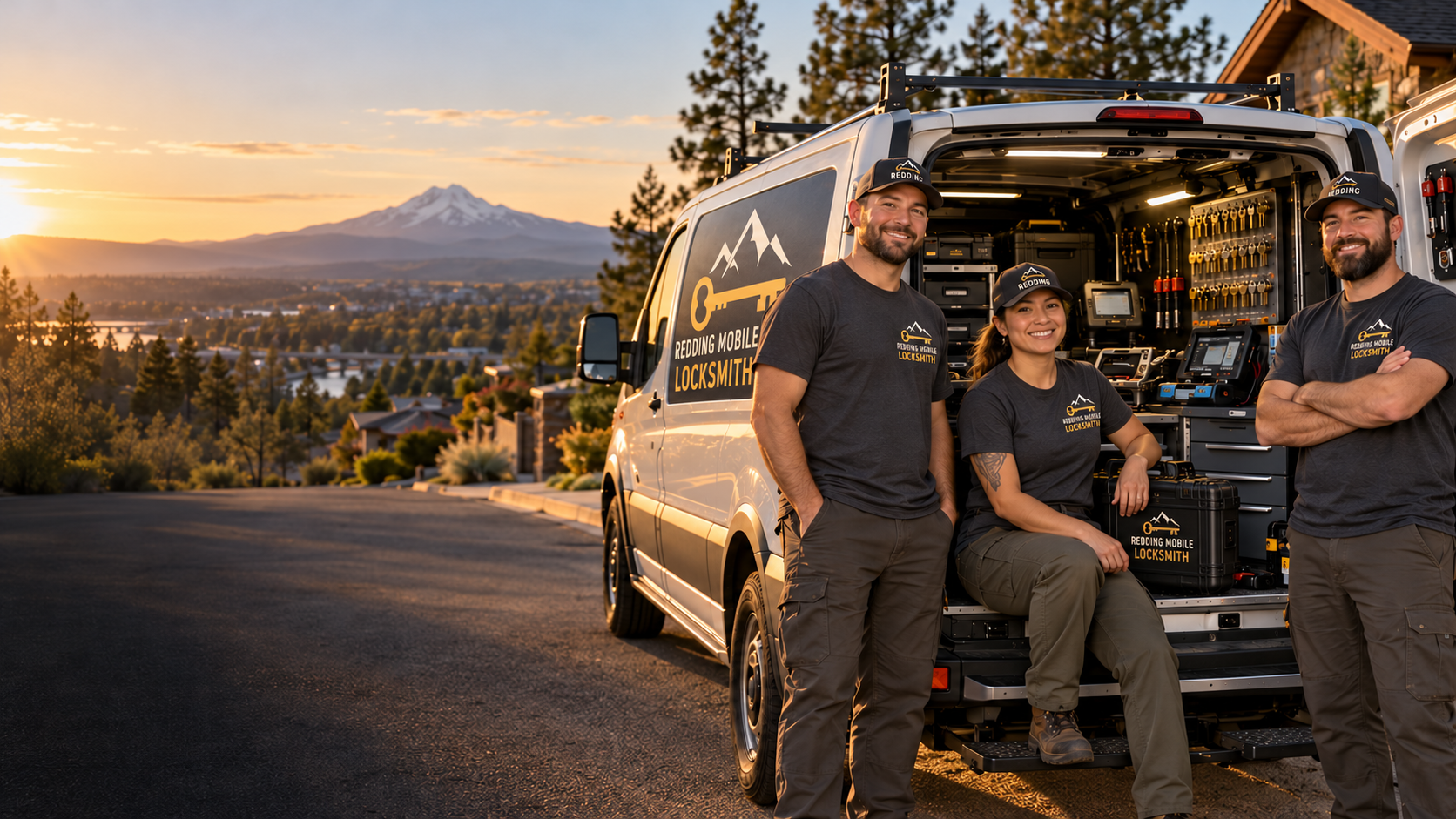
Our team works from a branded service van with uniformed technicians. We carry professional tools, key cutting and programming equipment and common hardware, so if the lock needs attention, we can often deal with it on the spot.
We serve Cottonwood, Anderson and Redding as well as many other communities, and we are available around the clock. For a wider look at what we do at homes, see our residential locksmith page, and for everything local to this community visit our Cottonwood area page. If your vehicle is locked too, see car lockouts in Cottonwood.
Common questions
What proof do I need to get back into my own house?
We ask for something that connects you to the address, such as a driver license, a lease, a utility bill or recent mail. If you are a guest or tenant, confirmation from the owner or manager helps. This protects you and every other homeowner.
Will you damage my door when you open it?
Our aim is to open the door without harming the door, frame or lock. A trained technician uses purpose made tools and chooses a method that suits your hardware. If a lock is already damaged, we tell you what we found and what it needs.
I rent my home. Can you still help?
Yes, once we confirm you are entitled to be there. A landlord or manager may have a spare key, and your lease may say who handles lock changes. We cannot give legal advice, so check your agreement if you want to change the lock afterward.
What if a child or someone vulnerable is inside?
Call emergency services first. Do not wait for a locksmith if a child, an older adult or anyone who may need help is locked inside the home. Once responders are on the way, you can also contact us and describe the situation.
Is it safe to hide a spare key outside?
Usually not. Under mats, in pots and above door frames are the first places a thief looks. A trusted neighbor, a small coded lock box fixed to something solid or a keypad lock is a better choice. Test any spare key you keep.
Do you serve homes on long driveways and gated land?
Yes. Cottonwood has many acreage and ranch properties, and we plan for gates, long drives and animals. When you request help, mention the gate code or access details and any loose pets or livestock so we can arrive prepared.