
Home / McCloud / House Lockout in McCloud
McCloud house lockout
House Lockout in McCloud: Back In Without Damage
When you are standing outside your own front door in a forest town, the goal is simple: get in without breaking anything. Here is the sensible order of options, from the simple checks to the professional visit.
What a house lockout really is
A house lockout sounds simple, but it comes in several different shapes. Sometimes the keys are inside and the door is latched. Sometimes the keys are lost and nobody is home. Sometimes the key is in your hand, but it will not turn, or the lock has failed on its own. Each version has a slightly different answer.
What they share is a person on the wrong side of a door, often at an awkward hour. In McCloud, a forest town east of Mount Shasta along Highway 89, that can mean a long wait for help if you try to arrange it the wrong way. A little knowledge about the order of options makes a big difference.
Our goal on a house lockout is always the same: get you in with the door and lock intact whenever possible, and tell you plainly if that is not possible. The doors in this part of the world are often old wood, and old wood does not forgive rough handling.
There is also the matter of time of day. A lockout at noon on a mild day is an inconvenience. The same lockout at midnight in a snowstorm, with no jacket and a phone running low on battery, is a safety matter. We treat the second kind with more urgency, and we ask the right questions early so that we can plan around cold, darkness and distance.
Picture a driver coming home after a long route
Imagine someone who delivers packages or gives rides all evening and finally gets home late. They have been in and out of the car dozens of times, juggling a phone, a bag and a ring of keys. They reach the front door and discover the house key is not where it should be. It might be in the vehicle, on a seat, or back at the last stop.
This is an illustration, not a real customer, but the pattern is real for anyone whose day is spent moving. The more often you handle keys, the easier it is to leave one behind. A person like this is tired, cold, and not interested in a long conversation. They want to know what to do and what it will take.
For them, the sensible order of options is a gift. It tells them which steps are worth trying at once, which to skip, and when it is time to ask for help rather than wasting an hour in the dark.
We also notice that people in that position often feel embarrassed. There is no need. Lockouts happen to careful people as often as to careless ones, and the only real mistake is making a bad situation worse by forcing something. A short request, followed by a calm visit, is a perfectly reasonable way to end the evening.
The simple checks that come first
Before calling anyone, walk around the house. A back door, a side door, a garage entry or a window may have been left unlocked. Check the places you may have left a spare: with a family member, a neighbor you trust, a property manager, or a lockbox you set up. Sometimes the answer is closer than it seems.
Look for a way to reach someone who is inside, if anyone might be. A housemate, a relative or a guest could open the door in a moment. If you share a house, send a message before assuming no one is home. It is amazing how often the door is opened by the person you forgot was there.
Do not climb onto roofs, force windows or kick the door. In snow and ice a fall is a serious risk, and the damage to a door or frame may cost more than any other part of the day. Our guide on hiding a key outside and better options explains why the old trick of a key under the mat is a risky plan.
- Try every exterior door and any garage entry before assuming the house is sealed.
- Contact anyone who has a spare key or may be inside.
- Check whether you left a key in a lockbox or with someone you trust.
- Never climb onto a roof or force a window in snow or ice.
When the door is simply not latched properly
Sometimes the problem is not that the door is locked, but that it is stuck. Older wood frame houses shift with the seasons, and a door can bind against its frame, especially after wet weather. Pushing firmly on the door near the latch while turning the handle sometimes frees it.
If a latch does not release, it may be a sign of a larger problem. A door that does not latch properly, or sticks when you try to open it, can point to alignment trouble. Our guide to doors that do not latch, alignment basics explains what to look for once you are inside.
The important point is not to take a hammer to anything. A stuck door is almost always easier to open with patience than with force, and damage to the latch or frame turns a simple problem into a repair job.
A useful test is to look at the gap around the door. If the gap at the latch side is tight or the door rubs at the top corner, the door is probably binding and not locked at all. Lifting the handle while pulling or pushing can take weight off the hinges and let the latch release, with no tools involved.
Why a locksmith is the safer next step
If the simple checks do not work, a professional visit is the next sensible step. A trained locksmith has tools made to open a door without harming the lock, the frame or the finish. We work through the lock itself, not around it, so the door should look the same afterward as it did before.
That is very different from the improvised approaches people sometimes try. Credit cards, screwdrivers and crowbars may work in films, but in real life they bend latches, split door frames and scratch finishes. A damaged door can become a security problem as well as a cosmetic one, because a weakened frame is easier to push open later. The strike plate, the part of the frame the bolt slides into, is often held by short screws into soft wood, and a hard shove can crack the wood around it without leaving an obvious mark.
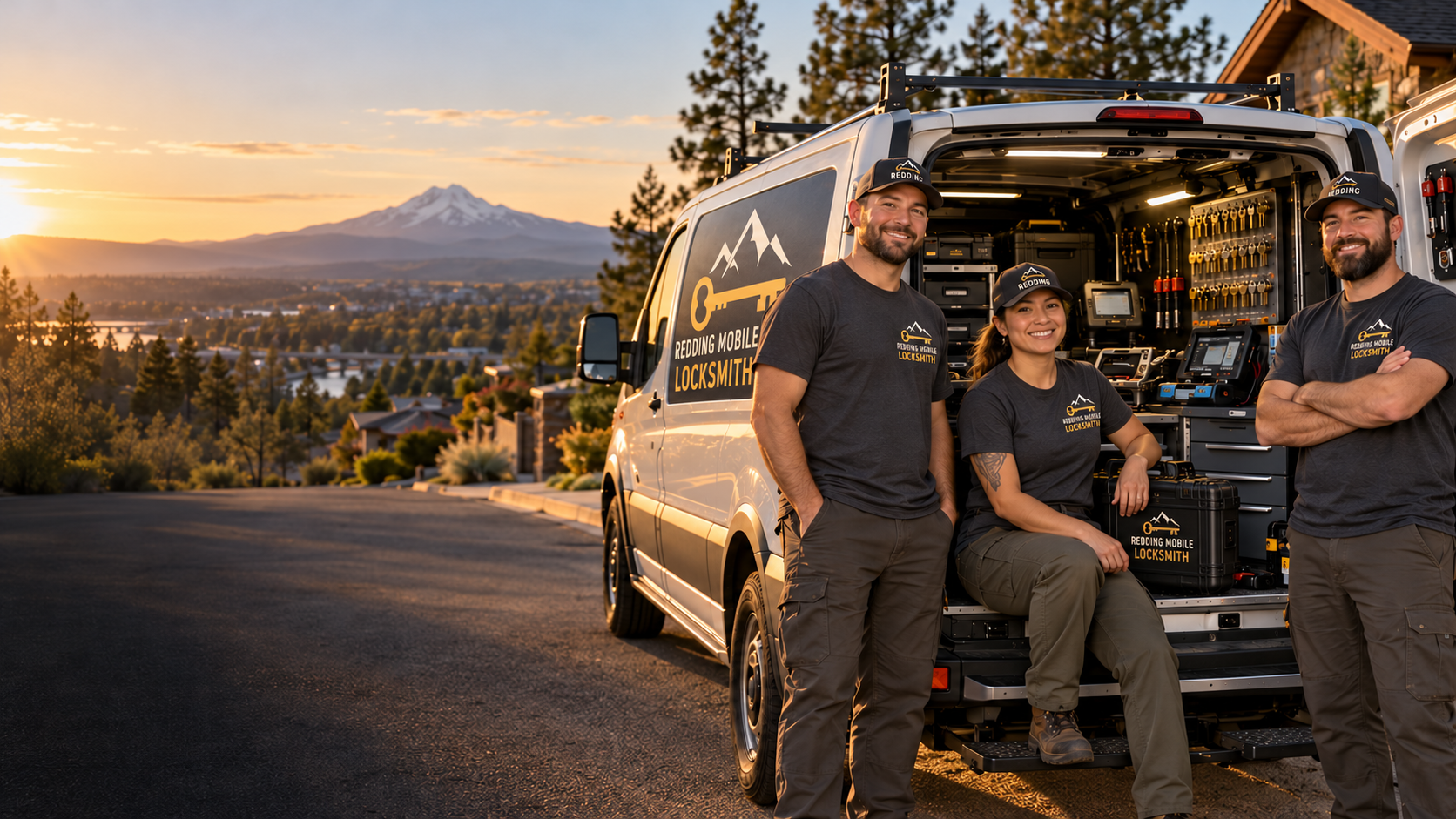
Our house lockout service is built around this idea. The team arrives in a branded van, in uniform, with professional tools and common hardware on board. We explain what we plan to do before we start, including whether any part of the lock is likely to be affected, and we check that the lock works properly when we finish.
Sometimes we find that the cause of the lockout is a lock that has been quietly failing for months. If so, we will show you what we see, whether it is a worn key, a loose cylinder or a latch that does not extend all the way. You then decide whether to leave it, repair it or replace it, with the facts in front of you.
What to tell us when you ask for help
Clear information helps us arrive prepared. Tell us the town, McCloud and ZIP 96057, and which door you are locked out of. Describe the lock: is it a deadbolt, a knob, a lever handle, a keypad? If you can see it, describe whether the door has more than one lock.
Tell us whether the keys are inside, lost, or in your hand but not working. If anything is on the stove, if a pet is inside, or if a person who needs help is inside, say so right away. For any emergency where a person is in danger, call emergency services first, and we can follow.
We also ask a simple question: is this your home? A responsible locksmith confirms that the person asking for access is entitled to it. That may mean showing identification or proof that you live there. It is not an obstacle. It is the protection that keeps your own door safe from anyone who would call pretending to be you.
If you are locked out of a rental, say so, and tell us whether the owner or manager can confirm that you live there. Rules about who may authorize work on a rental vary, so we may ask you to check with the owner before we change or replace anything. Opening a door is one thing, and altering the hardware is another.
Cabins, older homes and the doors they come with
Houses in McCloud range from older wood frame homes to cabins tucked among the trees. The doors on them vary just as widely. A cabin might have a simple knob lock, a deadbolt added later, a hasp on a side door, or all three. Some doors use older hardware that is no longer sold in the usual way.
Older hardware needs a gentle hand. We look at what is on the door before we do anything, and we choose a method that suits it. For some old locks, the right approach is slow and careful. For others, the lock is already so worn that it needs replacing once we have you inside.
Snow and cold affect all of this. Frozen weatherstripping can hold a door shut, stiff locks resist a key, and a thick coat of ice on the threshold can complicate everything. We bring the tools and patience to work through it, and we are used to the particular challenges of a mountain winter.
If a cabin has been closed up for weeks, locks may have stiffened from disuse, and an old key may stick even when it is the right one. Mention how long the place has been empty. That detail helps us decide whether to expect swollen wood, a seized cylinder or a latch that has not moved since last season.
After you are back inside: the sensible follow up
Once you are in, take a few minutes to think about why it happened. If a key was lost, you may want to rekey the lock so that the lost key no longer works. Our rekeying page for McCloud explains how that works and why it is often simpler than replacing the lock.
If the lock itself failed, consider a repair. Our page on lock repair in McCloud covers how we decide between fixing and replacing. And if your lockout started at your vehicle, the car lockout page may be useful too.
Finally, make a spare. Our guide to storing spare keys safely describes sensible places, such as a trusted neighbor or a secure lockbox, and the habits that make a spare actually useful. A spare that you cannot find is just a weight in a drawer.
If you have only one key at all, treat that as the first thing to fix. Have copies cut from the original, not from another copy, and label them in a way that makes sense only to you. A key tagged with an address is a gift to whoever finds it, so keep the tags plain.
Habits that prevent the next lockout
Most lockouts follow a pattern, and patterns can be broken. Pick one spot inside the door where keys always go. Pick one pocket where they always live when you leave. Do a pocket check before the door closes behind you, saying keys, phone, wallet if you must.
Be careful with doors that lock automatically. Some keypad and smart locks lock themselves after a short delay, which is useful until you step outside with the trash and the door closes behind you. If you use such a lock, learn how it behaves and keep a physical key or code available.
Share a spare with someone who lives nearby and will answer when you call. That single step prevents more lockouts than almost any other. It costs nothing but a favor, and it spares you from standing in the cold waiting for help.
For people who work on the road, consider keeping a house key separate from the vehicle key ring. If the vehicle keys are lost or locked in the car, the house key is still in your pocket. If you lose the house key at a stop, the car still starts. Two rings are more trouble to carry but they protect you from a double lockout.
Reaching us in McCloud
We are a 24 hour mobile locksmith serving Shasta and Siskiyou counties, and McCloud is part of that service area. Our phone line is coming soon, so for now the way to request help is the request form on our contact page. Tell us the door, the lock and the situation.
You can read more about the community on our McCloud area page, and about neighboring towns such as Mount Shasta. Wherever the door is, the aim is the same: a calm voice, a careful method and a door that still works afterward.
If you are reading this before you need it, keep the page in mind. A lockout is much easier when you already know what to check, what to say and what to expect. That knowledge turns a bad moment into a manageable one.
Common questions
What should I try before calling a locksmith for a house lockout?
Walk around the house and try every exterior door and any garage entry. Contact anyone who has a spare key or might be inside. Check for a lockbox or a trusted neighbor. Do not climb roofs, force windows or kick doors, because the damage and the risk of a fall are not worth it.
Will opening my door damage the lock or frame?
The aim is no damage at all. A trained locksmith works through the lock using tools made for the purpose, and the door should look the same afterward. Improvised methods such as credit cards, screwdrivers and crowbars are far more likely to bend the latch or split the frame.
Do I have to prove the house is mine?
A responsible locksmith asks, yes. We want to be sure the person requesting access is entitled to it, which protects you as much as anyone. Identification or something showing you live there is usually enough. Tell the dispatcher if you are unsure what you can provide.
My key is in my hand but will not turn. What now?
Do not force it, since that can snap the key in the lock. Check whether the door is binding by pushing or lifting it gently as you turn. If it still resists, the lock or the door may need attention, and a locksmith can open it and fix the cause.
Should I change my locks after a lockout?
Only if a key was lost or may be in the wrong hands. In that case rekeying makes the old key useless without replacing the lock. If the lockout was simply a forgotten key inside, a spare and better habits may be enough.
How do I request help in McCloud?
Our phone line is coming soon, so use the request form on the contact page and describe the door and what has happened. We are a 24 hour mobile locksmith serving Siskiyou County, including McCloud. If a person or pet is in danger inside, call emergency services first.