
Home / McCloud / Car Lockout in McCloud
McCloud car lockout
Locked Out of Your Car in McCloud? Stay Calm
A locked car in a forest town on Highway 89 can feel like a bigger problem than it is. Here is the steady way through it: what to check first, what to tell us, and what happens when the team arrives.
The first minute matters more than the first move
Almost everyone who gets locked out of a car does the same thing: they pull on the handle again, harder, as though the door might have changed its mind. Then they walk around the vehicle checking every other door. That is natural, and it costs nothing, but the next steps are where you can save yourself a lot of trouble.
Stop, take a breath, and look through the glass. Where are the keys? Is the engine running? Is anyone inside? Those three questions decide how urgent the situation is and what kind of help you need. A calm answer to them is the most useful thing you can give anyone who comes to help.
McCloud is a quiet forest town east of Mount Shasta on Highway 89, and a locked car here often means you are somewhere without a crowd around. That makes a clear head even more valuable. The rest of this page walks through the sensible order of things, the way a dispatcher would talk you through it.
Panic tends to make us do the things that cause damage: kicking at a door, hunting for a rock, or calling every friend in the phone book at once. A short pause costs nothing, and it usually reveals that the situation is more manageable than it first looked.
Picture a newcomer who just bought a house
Imagine someone who has just bought an older wood frame house in McCloud. They moved from a city, they are still learning where things are, and they have a new set of keys that they have not yet gotten used to. One evening they step out to grab something from the car and the door clicks shut behind them with the keys on the seat.
This is an illustration, not a real customer, but it is a pattern we understand. New homeowners are juggling two sets of keys, a stack of boxes and a head full of tasks. Lockouts happen in exactly those moments, when habits have not formed yet and a pocket check is easy to forget.
What helps such a person is not a lecture. It is a clear next step. We tell them what to look for, what to say, and what will happen when the team arrives, so the evening does not turn into a long worry. And if it also turns out they have not made a spare for either vehicle, we point that out gently afterward.
What to check before you call anyone
A short list of checks can sometimes end the problem in seconds. Walk around the vehicle and try every door, including the back doors and any rear hatch, since one may have been left unlocked. If you have a second key, a family member or a neighbor with a spare, ask yourself whether getting it is simpler than waiting.
Look at the phone you are holding. Many newer vehicles pair with a phone or a key fob, and some have an app or a service that can unlock the car remotely. Whether yours does depends on the vehicle, so we will not promise it, but a minute spent checking the manual or the glove box documents is worth it if you can reach them.
Do not try to force the window, wedge the door with tools, or use anything that could scratch paint, bend the frame or damage the weatherstripping. Those attempts can cause damage that costs far more than a lockout call. Our guide on keys locked in a running car covers the special case of an engine that is still on. In that case, mention it right away, because a running engine changes how we approach the door and how carefully we want to avoid bumping a gear shift or lever.
- Try every door and the rear hatch before assuming the car is fully locked.
- Look for a spare key at home or with someone nearby.
- Check whether the vehicle has a phone app or roadside unlock feature.
- Avoid prying, wedging or striking the glass or frame.
When it is an emergency, call emergency services first
There is one situation where this page matters less than a different phone call. If a child or a pet is inside a locked vehicle, call emergency services first. Cars heat up dangerously in summer sun and cool just as dangerously in winter, and no locksmith visit should be the first step when a life may be at risk.
Our guide to a child or pet locked in a vehicle, call emergency services first explains why. The people on that call can send help that is equipped for the situation, and they can give instructions while they do. A locksmith can follow, but should not be the first call.
The same goes for any situation where you feel unsafe. If you are alone at night somewhere dark and something feels off, move to a lit, populated place and call for help. A locked car can wait. Your safety cannot.
What to tell the dispatcher
Good information makes a lockout call run smoothly. Tell us the town, McCloud and ZIP 96057, and where you are standing. A cross street is not necessary, and we will not ask for anything you do not want to share, but the general location of the car helps us plan the trip.
Describe the vehicle in plain terms: the make, the model and the approximate year if you know them. Tell us whether you have a traditional metal key, a fob, or a push button start. Say whether the keys are visible inside, whether the engine is running, and whether anyone or anything is inside the vehicle.
It also helps to know whether the car is parked on a public road or on private property, and whether it is blocking anything. If you have proof that the vehicle is yours, such as registration or an insurance card, mention where it is. A locksmith should confirm that the person asking for help is the person entitled to enter.
None of this is meant to be a hurdle. It takes a minute, and it protects you as much as anyone, because it means a stranger cannot call and ask for a door to be opened on your vehicle. If you cannot produce proof on the spot, tell the dispatcher and we will explain what alternatives exist.
How a professional gets you back in
We will not describe bypass techniques in detail, and you would not want us to. What matters is that the method is chosen to protect your vehicle. A trained locksmith works through the door or its lock opening using tools made for the job, with attention to the weatherstripping, the paint and the electronics inside the door.
Modern vehicles complicate this. Side airbags, wiring harnesses and sensors live inside doors, and careless handling can damage them. That is a good reason not to improvise with a coat hanger. Our car lockout service page explains what we do in general terms and why a controlled approach protects your car.
Once the door is open, we check that it locks and unlocks normally, make sure you have your keys in hand, and leave things as we found them. A good lockout visit should leave no evidence of itself, apart from a vehicle you can drive away in.
We also take a moment to explain what happened. If the lock is worn, if a weak door seal let in moisture, or if a fob battery is running low, we say so. That way the lockout becomes useful information rather than just an inconvenience, and you know what to watch for.
Winter in a forest town changes the plan
McCloud has snowy winters, and snow brings its own lockout traps. Door seals freeze shut, key fobs lose battery strength in the cold, and locks that work fine in autumn develop a reluctance when the temperature drops. People also run vehicles to warm them up and step away, which is how keys end up locked in a running car.
Gloves are another surprise. Someone fumbling in thick gloves may drop keys into deep snow or set them on the roof while they scrape the windshield. A lock that seems jammed may actually be frozen, and a warm hand over the handle for a moment is gentler than a hammer. Before you assume something is broken, give the door a gentle push inward to break the ice seal and try again.
For habits that prevent winter lockouts, our guide on preventing snow day lockouts is worth a read. A spare key kept in a safe place away from the vehicle, rather than on a magnet under the bumper, is one of the simplest protections.
If you must leave a vehicle running to warm it, lock the doors with the fob only if you are sure the key is in your pocket, and keep your phone with you. Pause at the door and touch your pocket. It sounds almost silly, but it is the habit that stops the most winter lockouts in a forest town where help is not around the corner.
Lockouts that are really key problems
Sometimes the lockout is a symptom. If the doors will not unlock with the fob, the fob battery may be failing, or the vehicle's own battery may be low. If the key turns but the door will not open, a lock actuator inside the door may be weak. Fixing the symptom is only the first part of the job.
If you have lost the only key, getting inside is merely the start. The car still needs a key that will start it, and for many vehicles that means programming a new one. Our page on car key replacement in McCloud covers what is involved, and we can often handle the lockout and the new key in one visit. If we need to cut a key by code or from the vehicle itself, we will tell you what we need from you before we start.
We also keep an eye on whether the locking trouble might come from a worn key. A thin, rounded key that barely turns the door is on borrowed time. Replacing it now is easier than doing it after it snaps.
If the problem keeps recurring, it is worth asking whether the lock cylinder, the door handle linkage or the key itself is the weak link. We can look at each and tell you plainly which one needs attention, so you are not replacing parts that are still fine.
If your house is also part of the problem
People who lock themselves out of a car sometimes find that the house keys are with the car keys. If your keys are inside the vehicle and your home is locked too, you may need help at both doors. Tell the dispatcher so the team can plan for it.
Our house lockout page for McCloud explains how we approach getting back into a home without damage. It is worth reading before you ever need it, especially if you have just moved in and are still learning your own doors.
We also suggest that newcomers consider a small habit change: one dedicated place for keys, one spare of each key kept somewhere safe and away from the vehicle, and a pocket check at every door. Habits like these prevent the second lockout, which is the one that tends to happen at night.
Think of it as a short routine at each door: phone, wallet, keys. Say it out loud if it helps. People who build that routine in the first few weeks after a move tend to keep it, and the lockouts stop. Those who skip it often find out the hard way, usually when it is cold and dark.
Reaching us from McCloud and nearby towns
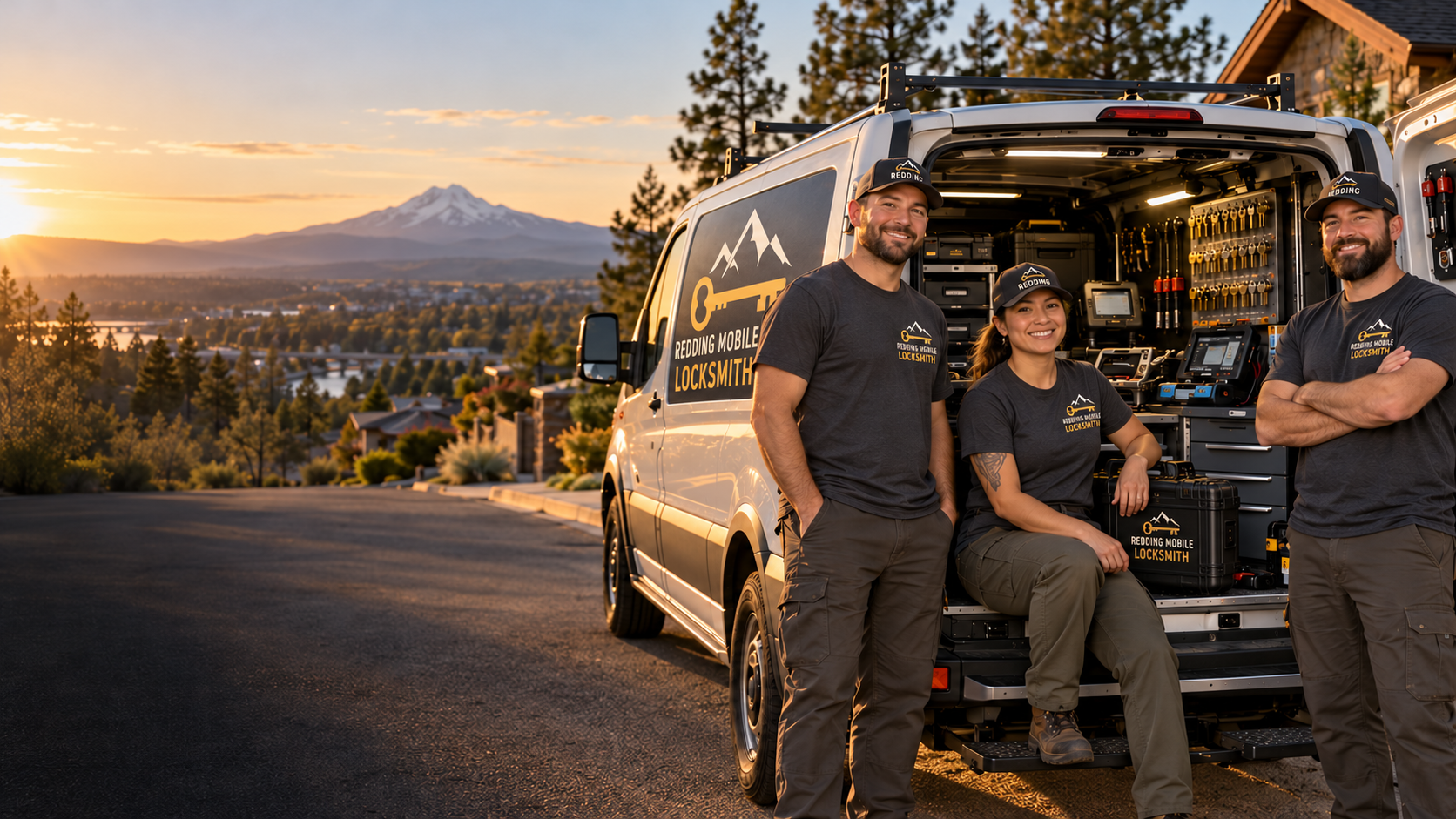
We are a 24 hour mobile locksmith serving Shasta and Siskiyou counties, and our team arrives in a branded service van with professional tools, key cutting and programming equipment, and common hardware. McCloud sits among the towns we serve, along with Mount Shasta and Dunsmuir nearby.
Our phone line is coming soon, so for now the way to ask for help is the request form on our contact page. Describe the vehicle, where it is and whether the keys are inside. If anyone is in danger, call emergency services first.
You can read more about the community on the McCloud area page. Whatever the situation, the goal is the same: a steady voice, a clear plan and a car that is unlocked without a mark on it.
If you are reading this ahead of time because you are new to the area, consider this page a plan you can keep. Know where your spare key is, know which of your vehicles use a fob, and know that help is available at any hour. A little preparation turns an alarming moment into a minor inconvenience.
Common questions
What should I do first if I lock my keys in the car?
Check every door, including the rear hatch, and look for a spare key or a phone app that can unlock the vehicle. Do not pry the door or window. If a child or pet is inside, call emergency services first. Otherwise, request a locksmith and describe the vehicle and where the keys are.
Can a locksmith open a car without damaging it?
A trained locksmith uses tools made for the job and works with care around the weatherstripping, paint and wiring inside the door. The aim is to open the vehicle with no marks. Improvised methods like coat hangers are more likely to cause damage, especially on newer vehicles.
What information helps the dispatcher most?
Give the town and general location, the make and model of the vehicle, whether it uses a key, fob or push button start, and where the keys are. Say if the engine is running or if a person or pet is inside. Have proof of ownership ready if you can.
Why do car locks act up in McCloud winters?
Cold shrinks metal parts, freezes moisture in door seals and weakens fob batteries. A lock that seems jammed may simply be frozen. Gently pushing the door inward can break an ice seal. If the lock stays stubborn, a locksmith can check whether the cause is the lock, the actuator or the key.
If I lost my only car key, can you help with the lockout and a new key?
Often both can be handled in one visit. We get you into the vehicle first, then discuss cutting and programming a new key. What is needed depends on the vehicle, and we explain the options before starting. Bring proof of ownership so we can confirm the car is yours.
How do I request help from McCloud?
Our phone line is coming soon, so use the request form on the contact page and describe your vehicle and location. We are a 24 hour mobile locksmith serving Siskiyou County, including McCloud. If someone is in danger or locked inside a vehicle, call emergency services first.