
Home / Sims / Car Key Replacement in Sims
Sims car key replacement
Car Key Replacement in Sims When You Have No Spare, or Do
A lost car key far from home is stressful, especially on the interstate corridor through the canyon. We come to your vehicle, cut and program a new key, and explain how a spare changes the job.
A lost key in the middle of the canyon
Sims is a small community in the Sacramento River canyon, north of Lakehead along Interstate 5, and a great deal of the traffic through it is people on their way somewhere else. Travelers pull off to stretch, to fish, to photograph the river or just to rest. A key can be lost in any of those moments, dropped on a trail, left on a picnic table, or fallen out of a pocket somewhere along the bank.
Losing a car key in a place you do not know is different from losing one at home. You may not have a spare within a long drive, and the nearest dealership is not close. The vehicle sits where it is, and you are left working out what to do next. That is the situation we are built to help with.
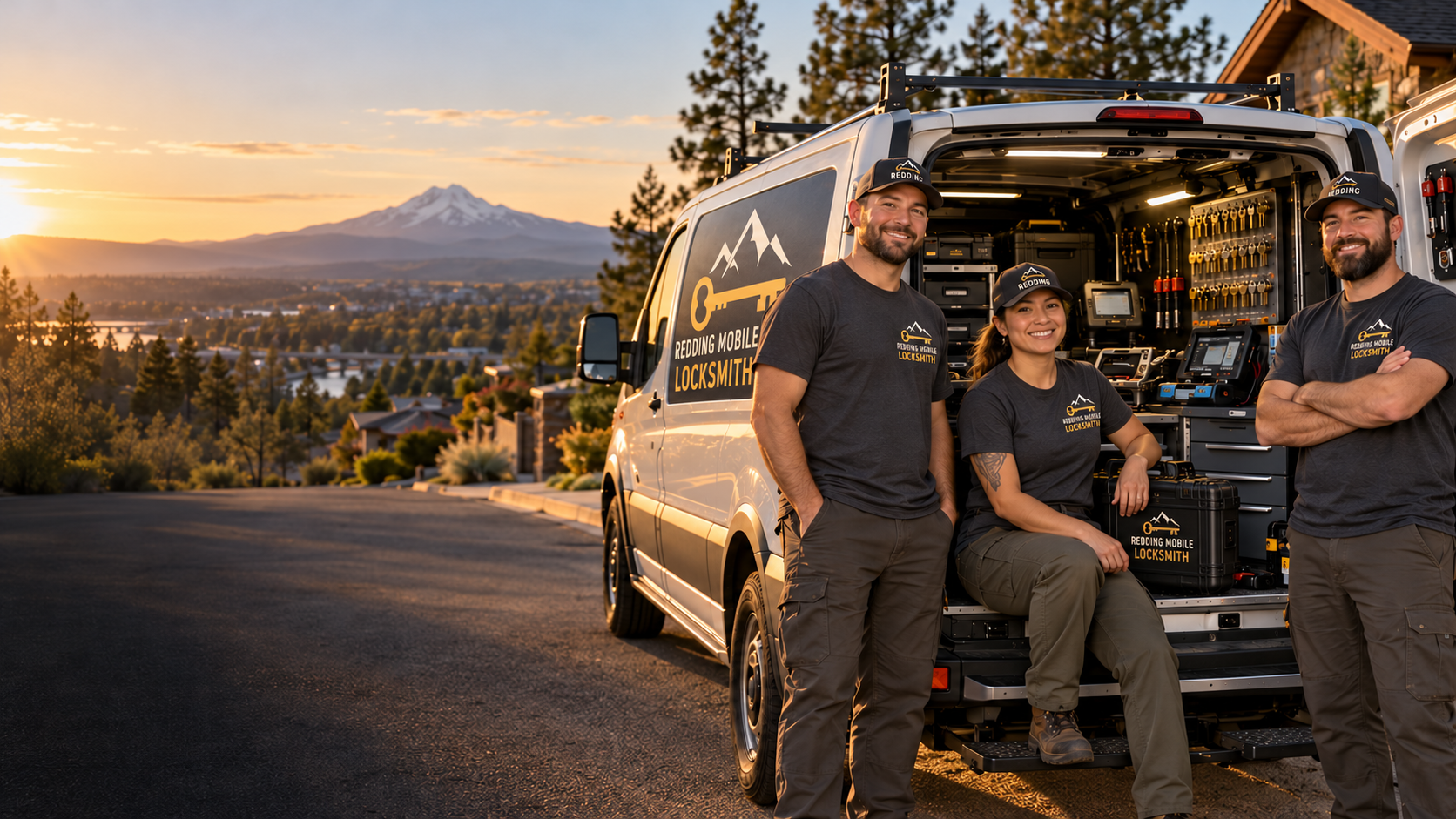
We are a 24 hour mobile locksmith team. Our branded service van carries key cutting and programming equipment as well as common hardware, so in many cases a replacement key can be made and tested right at your vehicle. Our car key replacement service page describes the process in general, and this page covers how it looks in Sims.
Not every lost key is truly lost. Before you assume the worst, retrace your steps, check coat pockets, bags, the seat cushions and any spot where you set things down. Look under the vehicle and around the door, since a key can drop and slide out of sight. A few calm minutes of searching sometimes ends the problem, and if it does not, you will at least know the key is gone for good.
Picture a traveler passing through on the interstate
Imagine a family driving north on Interstate 5 on a summer trip. They pull off near Sims to let the kids see the river. A short time later, the driver reaches into a pocket and the key is gone. It might be in the water, on the trail or inside the vehicle with the doors locked. Nobody knows, and there is no spare because that one stayed at home.
The family has a schedule, a place to be and no way to start the engine. They do not need a lecture about key control. They need someone to tell them clearly what is possible and what will be involved, so they can decide whether to wait for a locksmith or arrange something else.
Our approach is to ask a few precise questions about the vehicle, then explain the path. We find out if the doors are locked, whether the vehicle has a standard key or push button start, and whether there is a spare anywhere. From those answers we can describe the steps and bring the right equipment.
The family in this picture also has a practical decision to make about the rest of the trip. Some travelers choose to wait at the vehicle, others arrange a ride to somewhere warm and come back when the key is ready. Either is reasonable. We can tell you what to expect so you can make the choice with real information instead of worry, and so that nobody sits for hours wondering what is happening.
When you have no spare key
Having no key at all is called an all keys lost situation, and it is the hardest version of the problem. There is no working key to copy, so a new one has to be made from information about the vehicle itself. Often that means getting the key code from the vehicle's identification details and cutting a key to match.
For vehicles with a chip in the key, the key must also be programmed so the vehicle accepts it. Without that step, the new key may turn in the ignition but the engine will not start. This is the difference between an older vehicle and a newer one, and it is why we ask about the make, model and year.
We will ask you to show that the vehicle is yours, because making a key for someone else's vehicle is a serious matter. Expect to be asked for ownership paperwork and identification. This protects you, and we cannot proceed without it. Our note on what to gather when you have lost every key lists what to have ready.
Some vehicles have extra protections that make an all keys lost job more involved. The security system may need to be reset, or the computer may need to learn the new key before it forgets the old one. These steps take time and care, which is why we do not promise an outcome until we have seen the vehicle. We will tell you what applies to yours and what the process looks like.
- Proof that the vehicle is yours, such as registration or title.
- A photo identification that matches the owner.
- The make, model and year of the vehicle.
- The vehicle identification number, usually visible through the windshield.
- Any information about earlier keys or a fob you may have.
When you do have a spare
Having a spare makes things easier. If the spare is with you or nearby, we can often copy it, cutting and programming a new one that works the same way. This is generally simpler than starting from nothing, since a working key gives us a reference.
A spare also helps with the lost one. Some vehicles let you remove a lost key from the system, so it no longer starts the engine if someone finds it. We can explain what that involves for your vehicle. It is a useful step if the lost key could fall into the wrong hands.
If the spare is at home, a long way off, you have choices. Someone may be able to bring it to you, or you may decide it is simpler to have a new key made. We talk through both and let you choose. Our guide on a spare key now versus later explains why having a spare before you need one pays off.
If you do end up with a new key after a loss, treat that moment as a chance to fix the habit behind it. Cut a second spare, test it in the vehicle and keep it in a safe place away from the vehicle. A spare that lives in the glove box is no help when you are locked out, and a spare hidden outside the vehicle can be found by anyone. Home, or with a person you trust, is better.
Key types in plain words
Car keys come in several types. The oldest is the plain metal key, cut to fit the ignition and the doors, with no electronics. A transponder key has a small chip inside the plastic head that talks to the vehicle. A remote head key combines the key and the lock and unlock buttons in one piece.
Newer vehicles use smart keys, also called proximity keys, which you can leave in a pocket while the vehicle senses them and unlocks. A push button start replaces the ignition slot. Each type needs different equipment and a different process to replace. Our guide to car key types in plain words goes through them.
A chip in the key is why a hardware store copy often fails to start the engine. It turns, but the vehicle does not recognize it. The chip has to be paired with the vehicle, and that pairing is what we do with programming equipment. See our note on transponder keys explained for more.
Smart keys add one more layer. They rely on low power radio signals between the key and the vehicle, and each key carries its own code. When a smart key is lost, the vehicle must be told to accept a new one, and in some cases to forget the missing one. This is more involved than cutting a blade, but it is work our programming equipment is made for, and we explain each step as we go.
How the visit works at your vehicle
After you send a request, we confirm the details and the location. When we arrive, we verify ownership and identify the vehicle. We then work out the key type and gather the information needed to cut a new key. If the doors are locked, we open them first, using methods that avoid damage.
Next, we cut the key blade if the key has one, and we program the chip or fob if the vehicle needs it. We test everything: the door locks, the ignition or the push button start, and the remote functions. We do not leave until the key works as it should, every time you try it.
The work is done where the vehicle is, so you do not need to tow it, in most cases. Occasionally a vehicle's system needs more than we can do at the roadside, and we tell you at once so you can plan. We would rather be honest than leave you waiting in the cold.
Before we leave, we ask you to try the new key in every way you will use it. Lock and unlock the doors, open the trunk or hatch, start the engine, and try the remote buttons if there are any. We would rather you find a problem while we are standing next to the vehicle than ten miles down the road. Then we hand over the key, explain how to care for it and suggest cutting a spare.
What to prepare while you wait
Gather your documents first. Find the registration and your identification. If the papers are in the glove box and the vehicle is locked, tell us. Sometimes a phone photo of the registration or a document at home can help, though we will decide what is acceptable for proof.
Next, write down the vehicle details. The vehicle identification number is usually stamped on a plate at the base of the windshield on the driver's side, and it also appears on the registration. Have the make, model, year and color ready too.
Finally, stay in a safe place. If you are at a turnout or a roadside, keep away from traffic, and keep warm if it is cold. Keep your phone charged. Our request form is the way to reach us now, since our phone line is coming soon.
If a key is only missing and you are not sure it is gone, think about where the vehicle has been. Did you refuel, stop at a trailhead or let someone else drive? Ask the people who traveled with you. It is common for a key to sit in a jacket that someone else is wearing, or in a bag in the cargo area. Checking first can save the trouble of a replacement you did not need.
Weather, distance and the canyon
In the canyon, weather changes the experience of waiting. Winter brings cold and sometimes snow or ice, and summer can mean heat inside a closed vehicle. If you are traveling with children or pets, keep them comfortable and in a safe place. If anyone is inside a locked vehicle, call emergency services first.
Distance matters too. Sims is a small community with scattered buildings, so give us clear directions. Say which side of the road you are on, what is nearby and which direction you were traveling. If your signal is weak, tell us where you can get a bar or two.
If you are a long way from home, there may be other considerations, such as a place to stay while you wait. We keep our focus on the key, but we can advise on what needs to happen in what order. Our Sims area page and our pages for nearby communities such as Lakehead and Dunsmuir show where we work.
Replacing a worn or damaged key before it fails
Not every replacement is an emergency. A key that is bent, cracked or worn smooth may still work, but it is a failure waiting to happen. A fob with a cracked case or failing buttons is the same. Replacing it early, while you have a working original to copy, is easier and calmer.
A worn key can also damage the ignition. A rough or bent blade wears the pins and wafers inside, and over time it can cause trouble that is expensive to fix. If your key has begun to stick, turn hard or need jiggling, have it checked. Our note on ignition trouble signs lists what to watch for.
Fob batteries are another cause of apparent failure. A dead battery can look like a dead key. Before assuming you need a replacement, try a fresh battery. Our guide on key fob battery basics shows what to look for.
If a fob works only when held against the vehicle, or works from a short distance only, a weak battery is the likely cause. A fresh battery is a simple, low cost thing to try first, though some fobs need a little care to open without damaging the case. If you are unsure, bring the fob to the visit and we can check it along with the rest.
Other help for Sims drivers
If your keys are locked in the vehicle rather than lost, our page on car lockout in Sims explains that situation. If you are unsure which problem you have, tell us what happened and we will sort it out.
Our key programming page explains how chips and fobs are paired with vehicles, and our automotive locksmith page covers the full set of vehicle services.
Whether you are passing through or live in the canyon, a lost key is a solvable problem. Tell us the vehicle, tell us where you are, and we will come with the tools to make a new one.
Common questions
Can you make a key if I have lost all of them?
In most cases yes. We verify ownership, identify the vehicle, and cut and program a new key using the vehicle's details. Some vehicles are more involved than others, and we explain what applies to yours. Provide the make, model, year and proof of ownership in the request form.
What proof of ownership will I need?
Typically the registration or title and a photo identification matching the owner. This protects you from someone else making a key for your vehicle. If your papers are inside a locked vehicle or at home, tell us, and we will explain what we can accept.
Does a new key need to be programmed?
If your key has a chip, yes. The chip has to be paired with the vehicle before the engine will start. Older vehicles with plain metal keys do not need it. Our service van carries programming equipment, so most programming can be done at your vehicle.
Is having a spare really easier?
Usually. A working key gives us a reference to copy, and some vehicles let a lost key be removed from the system. With no spare, the key has to be created from the vehicle's details. Either way, we explain the steps before starting.
Will you need to tow my vehicle?
Most of the time no. We cut and program keys at the vehicle with equipment from our service van. In rare cases a system needs more than we can do on site, and we say so right away. We aim to keep you on the road.
How do I reach you if I am traveling through Sims?
Our phone line is coming soon. For now, use the request form on our contact page and give the vehicle details and your location. We are a 24 hour mobile locksmith team serving Shasta County and Siskiyou County, including the canyon communities along the interstate.